

A roof protects you from the rain, but it also adds weight, wind resistance, bulk, and often a much higher budget. Before comparing two vehicles, you first need to compare two different uses.
A covered electric tricycle is mainly worthwhile for riding sheltered from the rain and for replacing certain trips usually made by car. A Damius electric tricycle is more compact, lighter, and more geared toward individual mobility, strolls, and everyday errands. The best choice therefore depends less on the number of wheels than on the actual intended use, how often you ride in the rain, and storage constraints at home.
This article compares the two vehicle families without ruling out either one from the start, before explaining why Damius chose to stick with a compact, non-enclosed format.
The comparison at a glance
The two vehicle families do not meet the same starting need. One protects against bad weather at the cost of weight and bulk, the other stays light and maneuverable at the cost of full exposure to the weather. The table below summarizes the main differences before going into detail on each criterion.
| Criterion | Covered electric tricycle | Damius electric tricycle |
|---|---|---|
| Rain and wind protection | Very good, cabin or hood | Low, no bodywork |
| Bulkiness | Significant | Reduced, close to a classic bicycle |
| Weight | Often more than 100 kg | Between 30 and 45 kg depending on model |
| Transport by car | Difficult, even impossible | More feasible depending on model |
| Parking | Requires more space | Parks like a bicycle |
| Passenger transport | Possible on certain models | Designed for individual use |
| Everyday maneuverability | Variable, heavier build | Good, close to a bicycle |
| Errands | Good capacity depending on model | Practical rear basket |
| Purchase price | Often more than €6,000 | Starting at €2,490 |
| After-sales service in France | Varies by manufacturer | Provided from Miramas |
What exactly is meant by a “covered” electric tricycle?
The term “covered” covers very different realities. A simple roof does not mean an enclosed cabin. There are tricycles fitted with a removable hood, others with a windshield but no doors, and others still with genuine enclosed bodywork, similar to a velomobile or a small covered cargo vehicle. These differences completely change the actual level of protection, as well as the weight, bulk, and price.
One point deserves clarifying before any comparison. Search results often mix electric-assist bicycles that comply with French regulations with much more powerful enclosed tricycles, sometimes imported, fitted with motors well above 250 W. These vehicles do not fall into the same category and are not subject to the same obligations. It is therefore essential to check which category a model actually belongs to before comparing it to a standard electric-assist bicycle.
What sets a Damius electric tricycle apart
The Damius range remains built around a design focused on individual mobility. The riding position stays classic, close to that of a traditional bicycle, with a low frame that makes getting on and off easier. The differential, standard across the current range, improves cornering behavior by letting each rear wheel turn at its own speed. Depending on the model, the motor varies between a simpler front-wheel motor, as on the Essentiel, and a higher-torque mid-drive motor with automatic gear shifting, as on the Evasion Evo, better suited to hilly terrain.
For riding in the rain, the covered tricycle has the advantage
On this specific point, the comparison leaves no doubt. A cabin or hood effectively protects against rain, limits exposure to wind, and also offers better protection against the sun in summer. A Damius tricycle, like the vast majority of classic electric tricycles, offers no built-in protection against bad weather.
That said, it’s worth clarifying what a roof really means. It does not automatically guarantee heating, full watertightness, protection from sideways splashing in heavy rain, or the absence of condensation inside an enclosed cabin. These points vary considerably from one model to another and deserve to be checked during a test ride rather than assumed from a product sheet.
In terms of bulkiness, the advantage goes to the Damius tricycle
This is where the difference becomes most tangible in everyday life. Some covered tricycles have dimensions close to 2.50 meters long, 100 centimeters wide, and 1.85 meters high, with a weight that often exceeds 100 kilograms. A classic Damius electric tricycle measures about 1.80 meters long by 75 centimeters wide, with a weight of between 30 and 45 kilograms depending on the model.
This difference has very real consequences. A covered tricycle of this size does not always fit in a standard garage, a building elevator, or a narrow gate, whereas a Damius tricycle generally fits through without difficulty. The same logic applies to transport by car: a compact, lightweight model remains feasible on a trailer or in a car trunk, which becomes far more difficult with a vehicle weighing more than 100 kilograms. Finally, manually moving a tricycle with an empty battery is nothing alike between the two categories, something often discovered only after purchase.
Which is easier to ride?
Getting on and off is generally easier on a classic low-frame tricycle than on a covered vehicle, whose seat may be higher or more enclosed depending on the cabin’s design. Turning around or passing through a narrow space also favors the compact format, as a covered tricycle longer than 2 meters requires more room to maneuver. Some heavier covered models include power-assisted reverse, a feature rarely needed on a classic tricycle, whose lighter weight makes it easy to push back by hand. Maneuvering with the motor off is also noticeably easier with a lightweight vehicle.
Which is the most stable and reassuring?
Three wheels never mean a complete absence of fall risk, regardless of the vehicle category. At a standstill, both families offer perfect stability, unlike a two-wheeled bicycle, which has none. The center of gravity and cornering behavior depend more on geometry and weight distribution than on the mere presence or absence of bodywork.
One point deserves to be highlighted that is rarely mentioned elsewhere: bodywork improves protection against bad weather but also increases the surface exposed to crosswinds, which can affect stability in strong winds, particularly on open roads. Braking, behavior on cambered surfaces, and curb clearance remain points to test under real conditions rather than assume simply because a roof is present.
Which one should you choose for running errands?
A Damius tricycle comes with a practical rear basket for everyday errands, accessible without any special handling. A covered tricycle generally offers greater storage volume, sometimes supplemented by an enclosed trunk, which can make a difference for bulky or regular shopping trips. This extra capacity does come with a point of caution: a heavy load changes the vehicle’s cornering behavior, more so on a tall, bulky model than on a compact, low tricycle.
Can you carry a passenger?
Damius tricycles are designed primarily for their rider, with no passenger seat included as standard. Some covered tricycles, by contrast, allow one or more passengers to be carried, sometimes two adults and two children depending on the configuration, which brings them closer to family use or a partial replacement for a car. Whatever model is considered for this purpose, the maximum authorized load must be checked carefully, as it directly affects the vehicle’s safety and handling.
Range: which one actually goes further?
Comparing only the distances stated by manufacturers is not enough, as these figures almost always correspond to favorable conditions. It’s better to think in terms of battery watt-hours and take into account the vehicle’s total weight, the load carried, wind, temperature, and the route’s elevation changes. A heavier, covered vehicle generally consumes more energy for an equivalent distance than a lightweight tricycle.
One question deserves to be asked before buying: what happens if the battery runs flat along the way? Pedaling a 30 to 45-kilogram Damius tricycle without assistance remains feasible for most users. Moving an unpowered covered vehicle weighing more than 100 kilograms is a completely different matter, one to plan for before choosing this type of model.
Which is the most comfortable?
Weather protection clearly favors the covered vehicle, a real advantage on rainy days. Ease of getting on and off generally favors the classic low-frame tricycle, whose access remains simple and predictable. The difference between a saddle and a proper seat, the presence or absence of suspension, and the level of noise and vibration vary from one model to another and are best judged during a test ride rather than assumed from a spec sheet. One point is often overlooked: a cabin’s sun protection does not guarantee good ventilation, and some enclosed cabins can become uncomfortable in summer if airflow is insufficient.
Which is more visible in traffic?
A covered vehicle, being taller and bulkier, is generally more noticeable in traffic than a classic tricycle. However, this greater visual presence should not be confused with better protection in the event of an accident, as the two factors remain distinct and do not depend on the same features.
What budget should you plan for?
The Damius electric range runs from €2,490 for the Essentiel to €3,790 for the Evasion Evo, including battery and delivery of the tricycle ready to use. Covered electric tricycles are generally positioned well above that, often starting at €7,000 to €8,000 excluding options, due to the bodywork, the larger battery capacity needed to move a heavier vehicle, and more limited production runs.
Beyond the purchase price, you also need to consider battery replacement costs (much higher on a covered tricycle), possible insurance depending on the vehicle’s regulatory category, routine maintenance, and the availability of spare parts. An active after-sales service network in France, able to respond quickly to a breakdown or repair, weighs just as heavily in the decision as the price shown at the time of purchase.
Can you ride a covered electric tricycle anywhere?
A covered tricycle can absolutely remain an electric-assist bicycle (EAB) in regulatory terms, provided it follows the same rules as any electric-assist bicycle: assistance linked to pedaling, a maximum continuous rated power of 250 W, and assistance cutting off at 25 km/h. The roof or bodywork alone does not determine the vehicle’s category — it’s the power output and assistance mode that matter.
Some enclosed tricycles sold abroad far exceed these thresholds, with motors reaching 800 W or more. These vehicles no longer fall under the definition of an electric-assist bicycle and may require registration, specific insurance, or different equipment depending on their regulatory category. Before any purchase, it is therefore essential to check the exact approval status of the model being considered for use in France, whether covered or not.
The entire Damius electric range remains compliant as an electric-assist bicycle: 250 W, 25 km/h, assistance linked to pedaling, with no registration or specific mandatory insurance required.
Which model should you choose based on your use?
| Main need | Recommended choice |
|---|---|
| Strolls and individual mobility | Damius tricycle |
| Everyday errands | Damius tricycle |
| Low storage footprint | Damius tricycle |
| Occasional transport by car | Damius tricycle |
| Specialized after-sales service for adult tricycles in France | Damius tricycle |
| Frequent trips in the rain | Covered tricycle |
| Partial replacement for a car | Damius or covered tricycle |
| Regular passenger transport | Suitable covered tricycle |
| Year-round use regardless of weather | Covered tricycle |
Questions to ask yourself before choosing
Before deciding, it’s worth asking whether you’ll actually ride when it rains or simply avoid those days, whether passengers need to be carried regularly, how wide the door or gate is that the tricycle will need to pass through, where it will be parked day to day, whether it will sometimes need to be transported by car, whether a heavy vehicle can be moved by hand in case of a breakdown, whether your usual route includes hills, and finally whether the model being considered is properly approved for use in France. These answers guide the decision far more reliably than the mere presence or absence of a roof.
Verdict: covered electric tricycle or Damius?
A covered electric tricycle remains the most sensible choice if weather protection, passenger transport, and replacing short car trips are priorities. A Damius electric tricycle remains preferable for more compact, noticeably lighter individual mobility, suited to strolls, errands, and everyday trips, without the storage and handling constraints of an enclosed vehicle.
If the main criterion simply comes down to not getting wet, it’s worth seriously weighing the extra cost, weight, and bulk of a covered vehicle against how often the trips in question would actually occur.
The Damius electric range
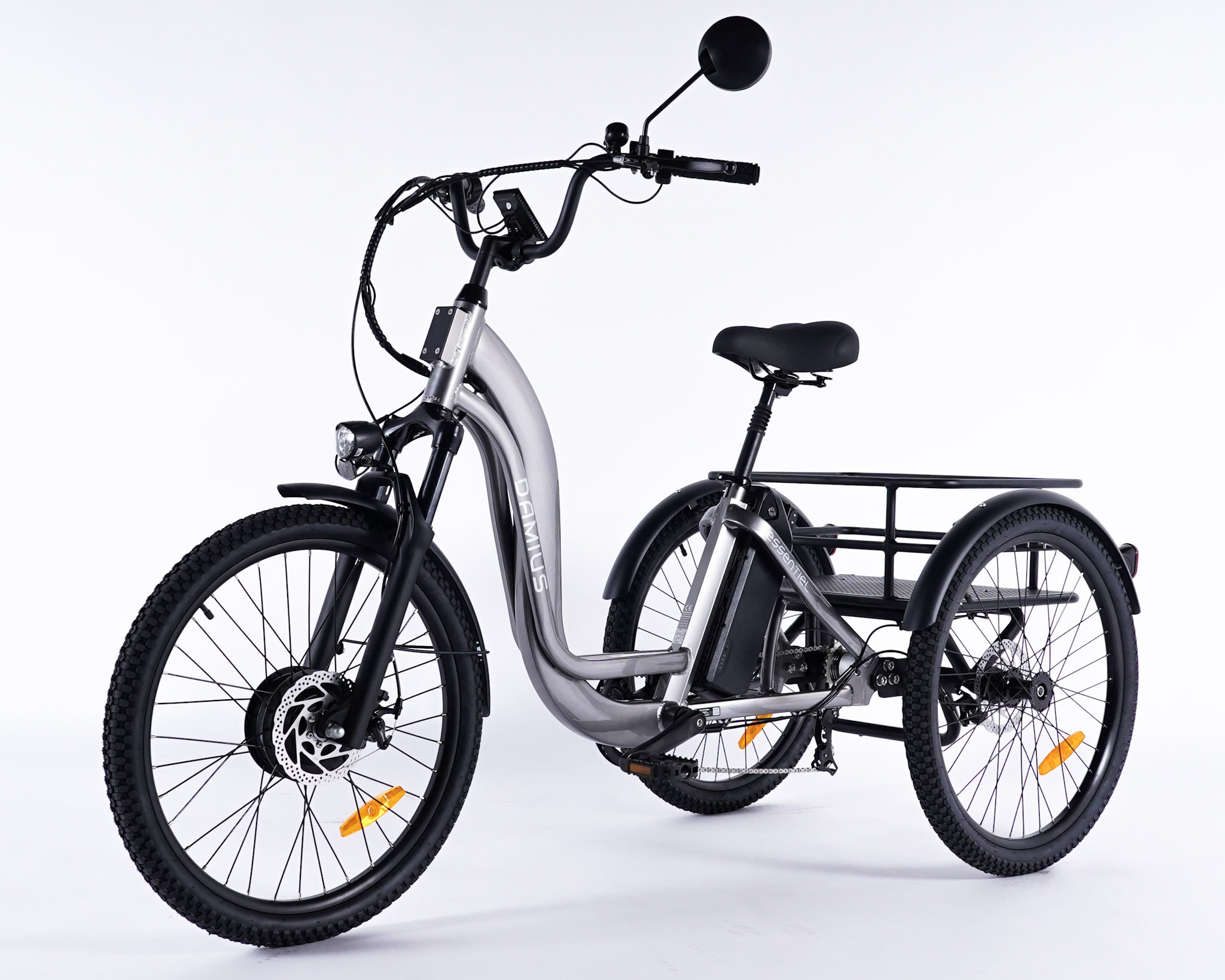 | Essentiel, €2,490 Front-wheel motor, standard differential, classic 7-speed derailleur. Compact, light, about 32 kg. The most accessible option for daily individual use. View the tricycle |
 | Evasion, €2,990 Best-seller of the range since 2016. Higher level of features and finishes, hydraulic brakes, Nexus derailleur, practical rear basket for errands. View the tricycle |
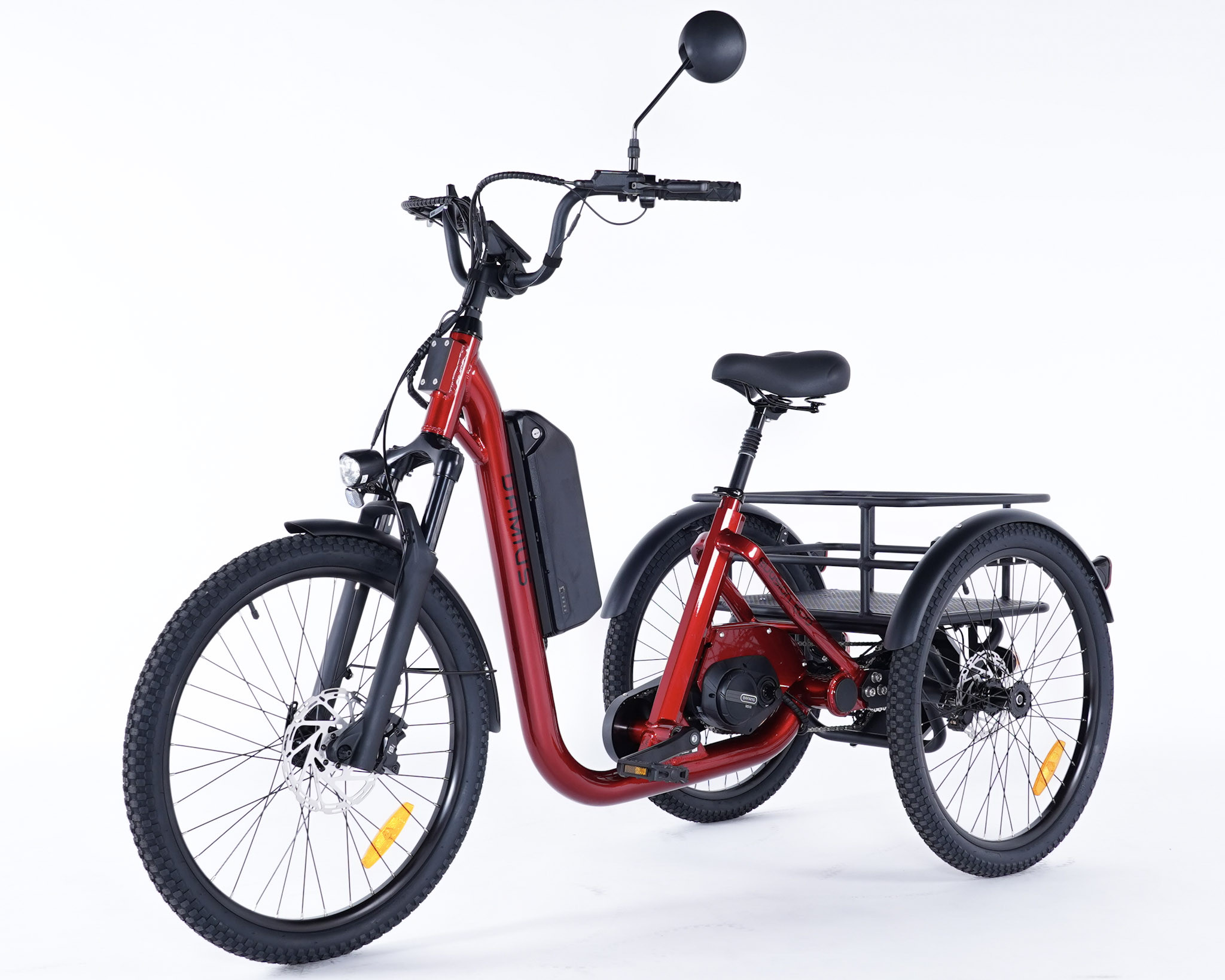 | Evasion Evo, €3,790 95 Nm mid-drive motor and automatic gear shifting. The easiest to use, especially on hilly terrain. View the tricycle |
Image path to verify before going live for the Evasion Evo visual, whose exact upload month could not be confirmed from this environment.
Torn between two Damius models?
Mathis and Charly are here to answer your questions and can organize a test ride suited to your needs.
| Compare the whole range | Purchase assistance | 04 90 59 49 10 |
Frequently Asked Questions
Is there a Damius electric tricycle with a roof?
No, the current Damius range does not offer an enclosed or covered version. All models remain designed in a classic format, with no built-in weather protection.
Can you add a roof to an electric tricycle?
Some umbrella-type or lightweight hood accessories exist on the market for classic tricycles or bicycles, but they do not offer the same level of protection as enclosed bodywork designed into the vehicle from the start, and they can affect its balance.
Can a covered electric tricycle ride on a bike path?
Yes, provided it meets the regulatory definition of an electric-assist bicycle: assistance linked to pedaling, a maximum power of 250 W, and cutoff at 25 km/h. A more powerful model falling outside this definition may not be allowed on bike paths.
What is the price of a covered electric tricycle?
Covered models observed on the market are most often priced from €7,000 excluding options, a budget noticeably higher than that of a classic electric tricycle like those in the Damius range.
Does a covered electric tricycle fully protect against rain?
The level of protection depends heavily on the model. A simple hood offers less protection than an enclosed cabin, and even an enclosed cabin does not completely rule out sideways splashing or condensation, depending on its design.
Which electric tricycle to choose for an elderly person?
For an independent person looking for simplicity, lightness, and ease of access, a classic tricycle like those from Damius generally remains the simplest choice. A covered model may be worthwhile if weather protection is a strong priority, provided you check how easy the vehicle is to maneuver and how much it weighs.
Can you carry a passenger on an electric tricycle?
Damius tricycles are designed for individual use, with no passenger seat as standard. Some covered tricycles allow one or more passengers to be carried, with a maximum load that should be checked before any such use.
Is a covered electric tricycle more stable?
Not necessarily. Its bodywork increases the surface exposed to crosswinds, which can affect stability in strong winds. Stability depends mainly on the vehicle’s geometry and weight distribution, not solely on the presence of a roof.
Which tricycle is easiest to park?
A classic, compact tricycle, like the Damius models, is generally easier to park than a longer, wider, heavier covered vehicle, which requires more parking space.
Can a Damius electric tricycle be transported in a car?
This remains more feasible than with a covered vehicle, thanks to its significantly lower weight and bulk, but the dimensions of the vehicle and the trunk should be checked case by case depending on the model.


