

An electric tricycle often costs 800 to 1,500 euros more than a conventional electric bike with comparable equipment. This gap is not a marketing gimmick. It stems from a different chassis, a more complex rear end, a motor system that must move more weight, and production carried out in much lower volumes.
The price difference between an electric-assist bike and an electric tricycle often surprises at first glance. Both feature a battery, a motor, and a controller. Yet the gap remains real, even between models of an equivalent range. The reason is not just an extra wheel placed on a bike. It is due to a different architecture, designed from the chassis through to the transmission, and a production scale that is incomparable to that of a conventional electric bike.
An electric tricycle is more complex to manufacture than an electric bike
A specific, reinforced, and bulkier frame
An electric bike relies on two aligned points of contact. A tricycle relies on three points distributed in a triangle, which entirely changes the mechanical stresses on the chassis. The frame must withstand torsional forces during cornering that a conventional bike rarely experiences, and support a rear width that a bike’s single tube does not have to manage. This frame cannot be a simple adaptation of a bicycle frame; it is designed and tested for this three-wheeled configuration.
A much more complex rear end
On an electric bike, a single rear wheel receives the transmission. On a tricycle, two rear wheels must turn together without forcing against each other, particularly in corners where they do not travel the same distance. This is the role of the differential, featured as standard on all current Damius tricycles, which distributes power between the two wheels and prevents premature tire wear or unpredictable behavior in curves. This part, its integration, and its adjustment represent a cost that the electric bike simply does not have.
More materials and more components
A complete third wheel, with its tire, inner tube, and hub. An axle or a differential. Additional fenders. A braking system sized for three wheels. Often a basket or a storage box. Each element adds a part cost and an assembly cost that a standard electric bike does not incur.
The motor system must move more weight
An electric tricycle generally weighs more than an equivalent electric bike, due to the reinforced chassis, the third wheel, and additional equipment. The motor, battery, and controller must therefore be sized for this extra weight, otherwise the assistance would lose efficiency on climbs or over long distances. This does not mean that all tricycles necessarily carry a more powerful battery than an electric bike: it depends on the model and the intended use. On Damius models, for example, the Essentiel and Essentiel Fatbike use a hub motor with a cadence sensor, while the Evasion Evo is equipped with a Bafang M510 mid-drive motor, with 95 Nm of torque and automatic gear shifting, specifically designed to compensate for this extra weight on hilly journeys.
Specific components cost more
| Electric bike | Electric tricycle |
| Mass-produced frame | Specific, reinforced frame |
| Two wheels | Three wheels |
| Conventional transmission | Transmission with differential depending on the model |
| Standard bike braking | Braking adapted to weight and 3 wheels |
| Largely standardized components | More specialized parts |
| Very broad market | Very restricted market, lower production volumes |
Electric tricycles are manufactured in smaller series
This is undoubtedly the most decisive factor, and the most rarely explained. The electric bike benefits from a mass market, with volumes that allow for the amortization of tooling, molds, and supplier negotiations over hundreds of thousands of units. The electric tricycle remains a niche market, focused on seniors, people with reduced mobility, and certain professional uses. Development, tooling, assembly, storage, and distribution are spread over far fewer units, which mechanically increases the unit cost, even at comparable manufacturing quality.
Transporting and storing a tricycle also costs more
A tricycle occupies much more volume than a bike in a box, a warehouse, or a delivery truck, even though its weight is not always proportionally higher. The logistics cost per unit is thus increased, a factor that price comparisons almost always omit. At Damius, final assembly, testing, and after-sales service are still carried out in Miramas, which allows this stage to be controlled rather than fully subcontracted to an external distribution network.
Electric tricycles for seniors often feature additional equipment
Depending on the model, you will find a low-entry frame for easy step-through, a more comfortable saddle or seat, a large-capacity basket or box, integrated lighting, brakes adapted to the vehicle’s weight, reinforced wheels, sometimes suspension, and simplified controls. This equipment is not systematic on all electric tricycles, but it is common on models designed for senior use, as is the case at Damius, where the 400-euro cargo box remains compatible with the entire current range except for the 20-inch Evasion Mid-Drive.
How much does an electric tricycle cost compared to an electric bike?
The following ranges reflect prices observed in September 2026 and change regularly according to brands and promotions.
| Vehicle type | Indicative price range |
| Entry-level electric bike | Approximately €1,000 to €1,500 |
| Mid-range electric bike | Approximately €1,800 to €2,800 |
| Simple electric tricycle (Damius Essentiel) | Approximately €2,490 |
| Comfort electric tricycle (Damius Evasion) | Approximately €2,990 |
| Mid-drive electric tricycle (Damius Evasion Evo) | Approximately €3,790 |
| Specialized high-end electric tricycle | Over €4,000 |
Is a more expensive electric tricycle necessarily better?
No. Price alone says nothing about the actual quality of the vehicle. What justifies a consistent price difference is the strength of the frame, the quality of the motor and its torque, the actual capacity of the battery and its lifespan, the presence or absence of a differential, the quality of the braking, the availability of spare parts, the warranty period, and the responsiveness of the after-sales service. A more expensive tricycle without improvements in these specific areas does not necessarily justify its extra cost.
Why are there still low-priced electric tricycles?
Price differences between electric tricycles are generally explained by lower battery capacity, more generic components, a reduced level of equipment, less controlled assembly, a shorter warranty, and less available after-sales service in the event of a breakdown. Before comparing only the displayed prices, it is better to check these points one by one, model against model.
Where do the extra euros go?
The extra cost of an electric tricycle can be broken down quite precisely. The specific and reinforced chassis absorbs a significant part of the difference. The third wheel, with its tire and hub, adds a direct part cost. The rear end and its transmission, including the differential on models equipped with one, represent one of the most technical areas. Braking adapted to the vehicle’s weight follows. The motor system and battery, sized to move a larger mass, also factor into the calculation. Finally, low manufacturing volumes, transport costs related to bulk, and distribution with after-sales service complete the list. None of these items is incidental, and it is their accumulation that explains a price gap that may seem disproportionate at first.
Is the extra cost of an electric tricycle justified?
The question should be brought back to the need rather than a raw price comparison. For a person who does not need a third wheel to solve a balance problem, a conventional electric bike remains the most economical and industrially amortized solution. For a person specifically looking for the stability, ease of mounting, or transport capacity of a tricycle, comparing its price only to that of a standard electric bike makes little sense: they are two different architectures, designed for different uses, and the price reflects this difference more than an unjustified margin.
Damius has been designing its electric tricycles in France since 2016 and manufactured them in-house until 2025. Since then, production has been subcontracted to China, while design, final assembly, testing, and after-sales service remain handled in Miramas by the technical team, notably Cédric for assembly, Sébastien for road tests, and Jérémy for after-sales follow-up, as well as Clément and Damien for design. This industrial choice allows prices to be kept consistent with the electric tricycle market, without sacrificing the quality control carried out before each shipment.
Damius Electric Tricycles
 | EssentielFront hub motor with cadence sensor, differential as standard. The most economical entry point in the range, at €2,490. |
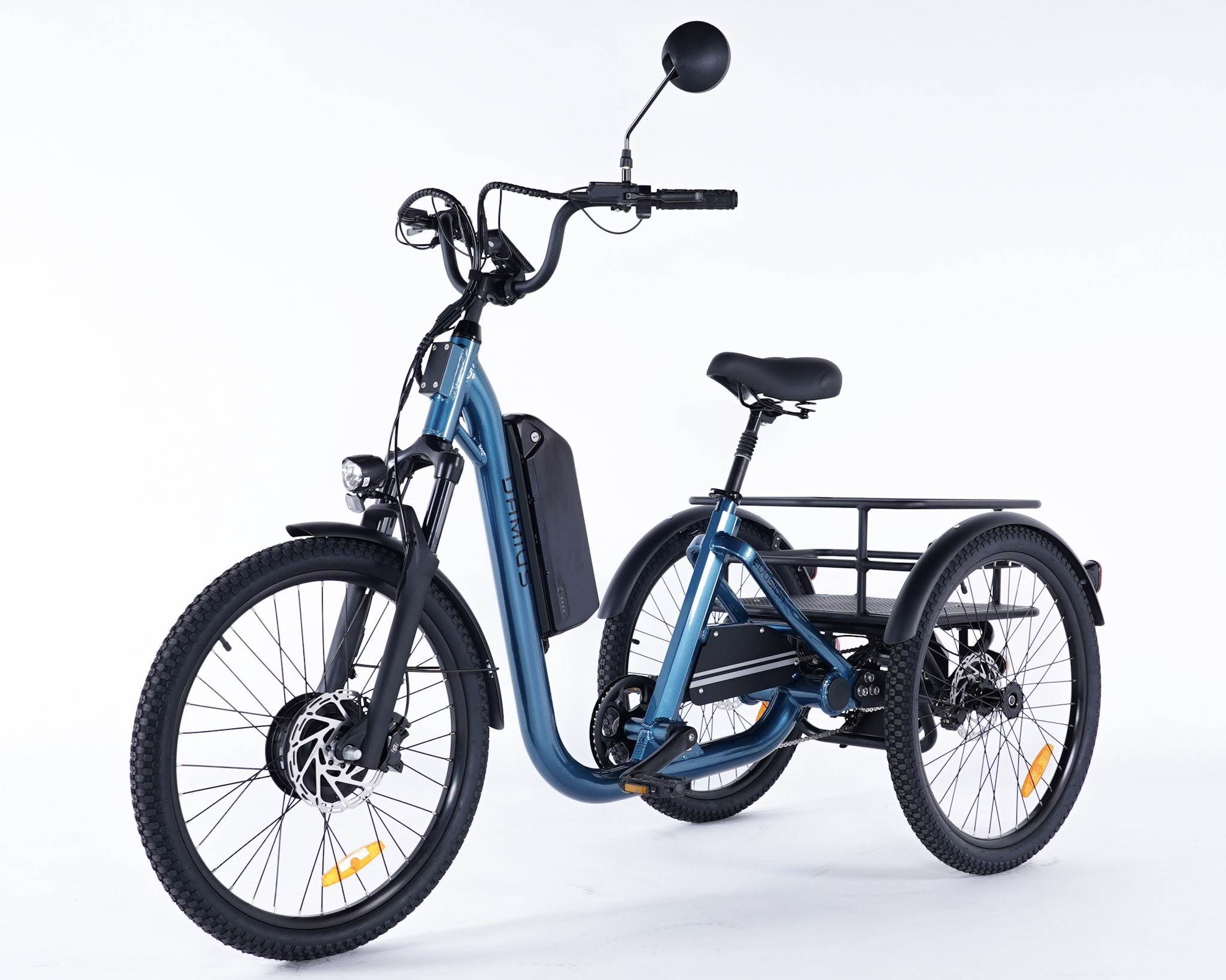 | EvasionThe Damius bestseller since 2016, with a differential, hydraulic brakes, turn signals, and Nexus derailleur. At €2,990. |
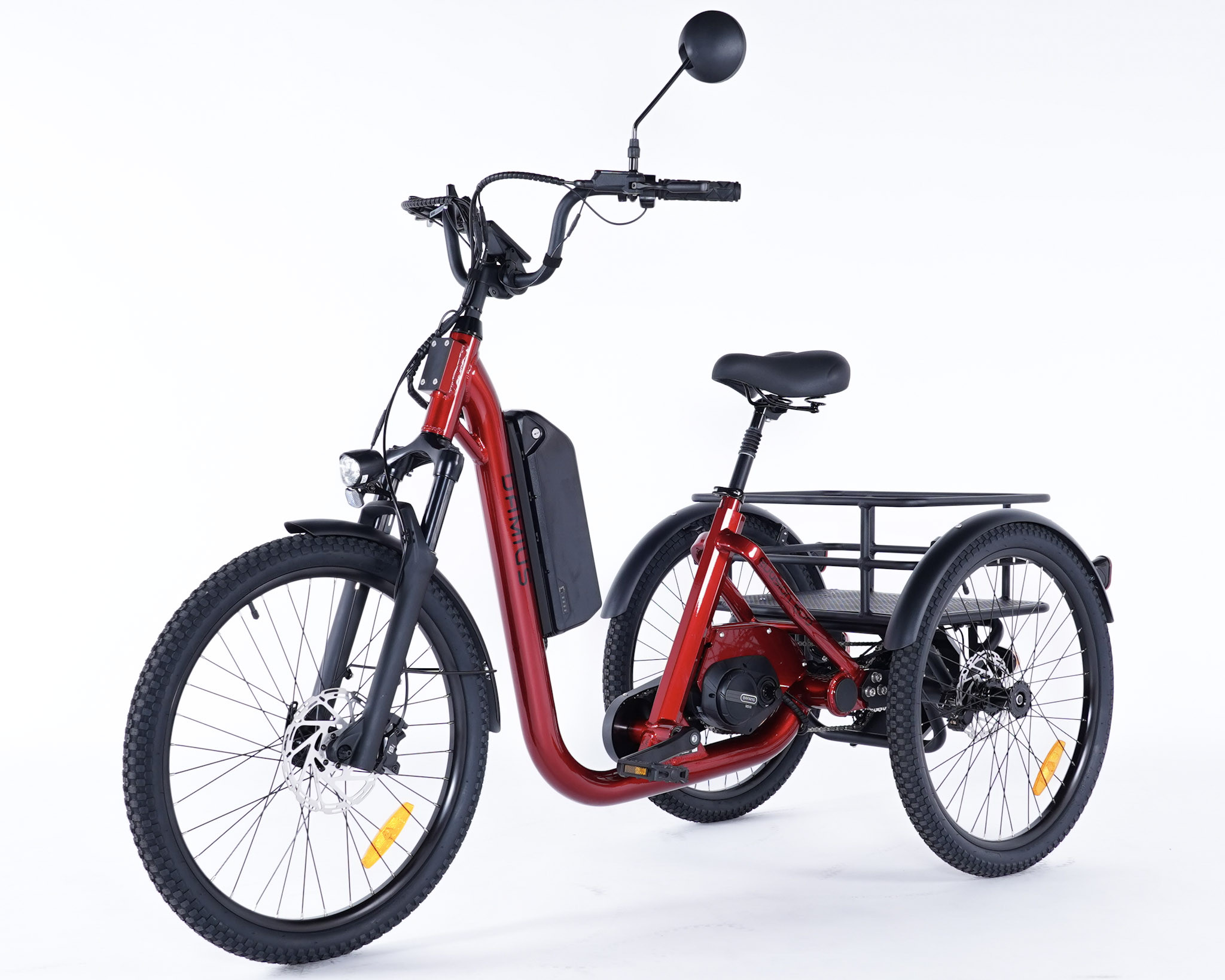 | Evasion EvoBafang M510 mid-drive motor, 95 Nm of torque, automatic gear shifting, designed to compensate for weight on hilly journeys. At €3,790. |
| Compare Damius tricycles | Try a model in Miramas | Call Mathis or Charly |
FAQ
Why is an electric tricycle so expensive?
Because it combines a specific frame, a third wheel, a more complex rear end, a motor system sized for a higher weight, and production carried out in lower volumes than a conventional electric bike.
What is the average price of an electric tricycle?
Expect to pay between 2,500 and 4,000 euros for a serious model intended for regular use, depending on the motor, equipment, and brand. At Damius, the range extends from €2,490 to €3,790.
Are there cheap electric tricycles?
Yes, but a very low price is almost always accompanied by a lower-capacity battery, more generic components, a reduced warranty, and limited or even non-existent after-sales service. Very often below the €2,000-€2,500 mark, these are foreign factories selling directly through websites without any real service or solid warranty.
What is the lifespan of an electric tricycle?
A well-maintained electric tricycle with a quality frame can last for many years. The battery remains the element that wears out the fastest and generally needs to be replaced before the rest of the vehicle. At Damius, the batteries are made in France!
How much does an electric tricycle battery cost?
The price varies according to capacity and technology, generally between 300 and 700 euros for a quality replacement battery. This cost must be integrated into the overall budget calculation, beyond the purchase price alone.
Does an electric tricycle cost more to maintain?
Maintenance may be slightly higher than that of an electric bike, particularly because of the third wheel, but remains reasonable on a well-designed model with available after-sales service and accessible parts.
Are there grants available for buying an electric tricycle?
The national bike bonus ended on February 14, 2025. Since December 1, 2025, a new LPP nomenclature covers certain cycles adapted with several wheels, and PCH or MDPH assistance remains possible depending on the situation. It is recommended to check the updated conditions with your MDPH.


