
Many buyers type this search without finding a clear answer. The term “Dutch-style tricycle” does not refer to a specific model, but to a family of adapted bikes, often with a low seat and extensive customisation, imported from the Netherlands. A Damius tricycle follows a different approach. Here is what truly sets them apart, and when each one makes sense.
Key takeaway
A Dutch-style electric tricycle can be relevant for someone who needs a seat with a backrest, a very low centre of gravity, or an advanced ergonomic setup for a specific disability. A Damius tricycle focuses on something else: strong value for money in terms of equipment, a controlled weight, a riding position close to a traditional bicycle, and after-sales service based in France. The choice mainly depends on the riding position you are looking for, your available budget, and the level of customisation you truly need.
Comparison at a glance
Before going into detail, here are the main differences between a Dutch-style tricycle and the current Damius range.
| Criteria | Dutch-style tricycle | Damius |
|---|---|---|
| Riding position | Highly variable, from classic design to a low seat with backrest | Close to a traditional bicycle, upright back |
| Low step-through frame | Yes on most models | Yes, easy step-through |
| Differential | Available on high-end models | Standard on all current models |
| Average weight | Often high, 40 to 60 kg depending on configuration | 30 to 40 kg depending on the model |
| Grocery carrying | Options depending on the model | Large rear basket included, cargo box optional |
| Distribution | Network of specialist dealers | Sales and after-sales service directly in France, in Miramas |
| Price | Often between €5,000 and €8,000 for highly customised models | From €1,790 to €3,790 depending on the model |
What is meant by a Dutch-style electric tricycle?
It is not a single type of tricycle
In reality, the expression covers three different things. It can refer to the geographic origin of a brand, an upright riding design inherited from Dutch utility bikes, or an adapted bike designed for a specific medical need, with a reclining seat and adjustable backrest. These three uses have very little in common, which is precisely what makes the search confusing. A classic Dutch tricycle looks more like a Damius tricycle than a Dutch low-seat tricycle, even though both carry the same label.
Two very distinct families among Dutch manufacturers
On one side, tricycles with a classic design, with saddle and handlebars in a position close to a traditional bicycle. On the other, models with a full seat, adjustable backrest and forward-set crankset, designed for people who can no longer hold handlebars while standing on the pedals, or who want a very low centre of gravity. Price, weight and overall size vary enormously between these two families, often by a factor of two.
What defines a Damius tricycle
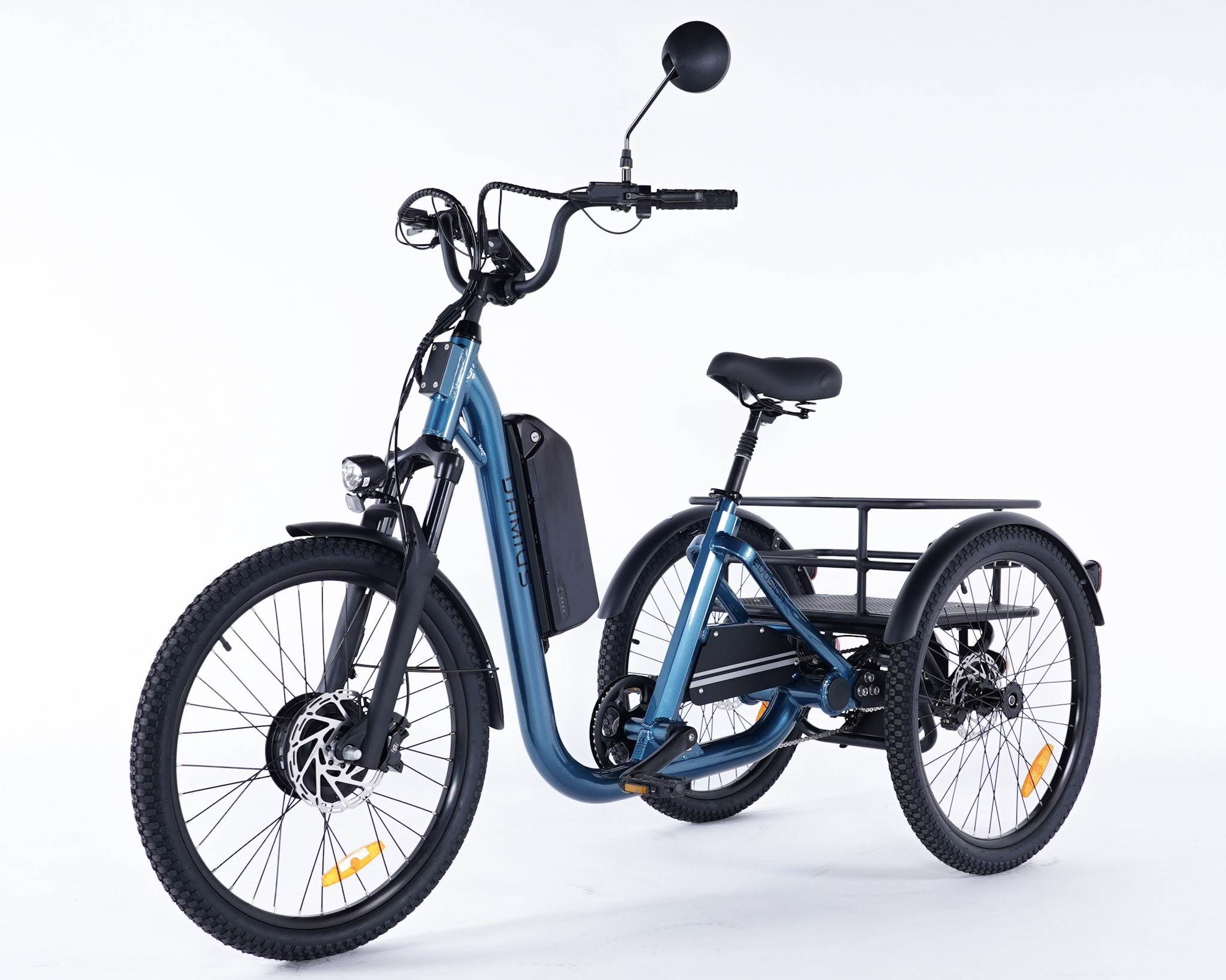
The Damius range is built around a low step-through frame design, with a differential fitted as standard on all current models, disc brakes with a parking function, and a rear basket designed for everyday use. Depending on the model, the tricycle is equipped with a front hub motor or a mid-drive motor, with gearing suited to local terrain. The whole range remains within standard e-bike regulations: 250 W, assistance limited to 25 km/h, which means no registration or specific equipment is required, unlike quadricycles or L2e-category models.
Good to know
Damius tricycles are designed and assembled in Miramas, in the south of France, in Provence. Since late 2025, part of the manufacturing has been outsourced, but final assembly, quality checks, design follow-up and after-sales service are still handled in-house, in France.
Riding position: the most important difference
The classic Dutch tricycle: a higher position
On Dutch models with a traditional design, the rider remains seated on a saddle and pedals downward, in a posture close to a city bike. Access height remains moderate and the overall size is similar to a Damius tricycle, around 180 cm long and 75 cm wide.
The Dutch low-seat tricycle
On models designed for adapted use, the rider sits in a real seat with a backrest, legs extended forward, in a much lower position. The centre of gravity drops significantly, which reassures some users, but the vehicle often extends beyond 2.20 m and the weight frequently rises above 55 kg with the battery.
The Damius position: close to a traditional bicycle, but more comfortable
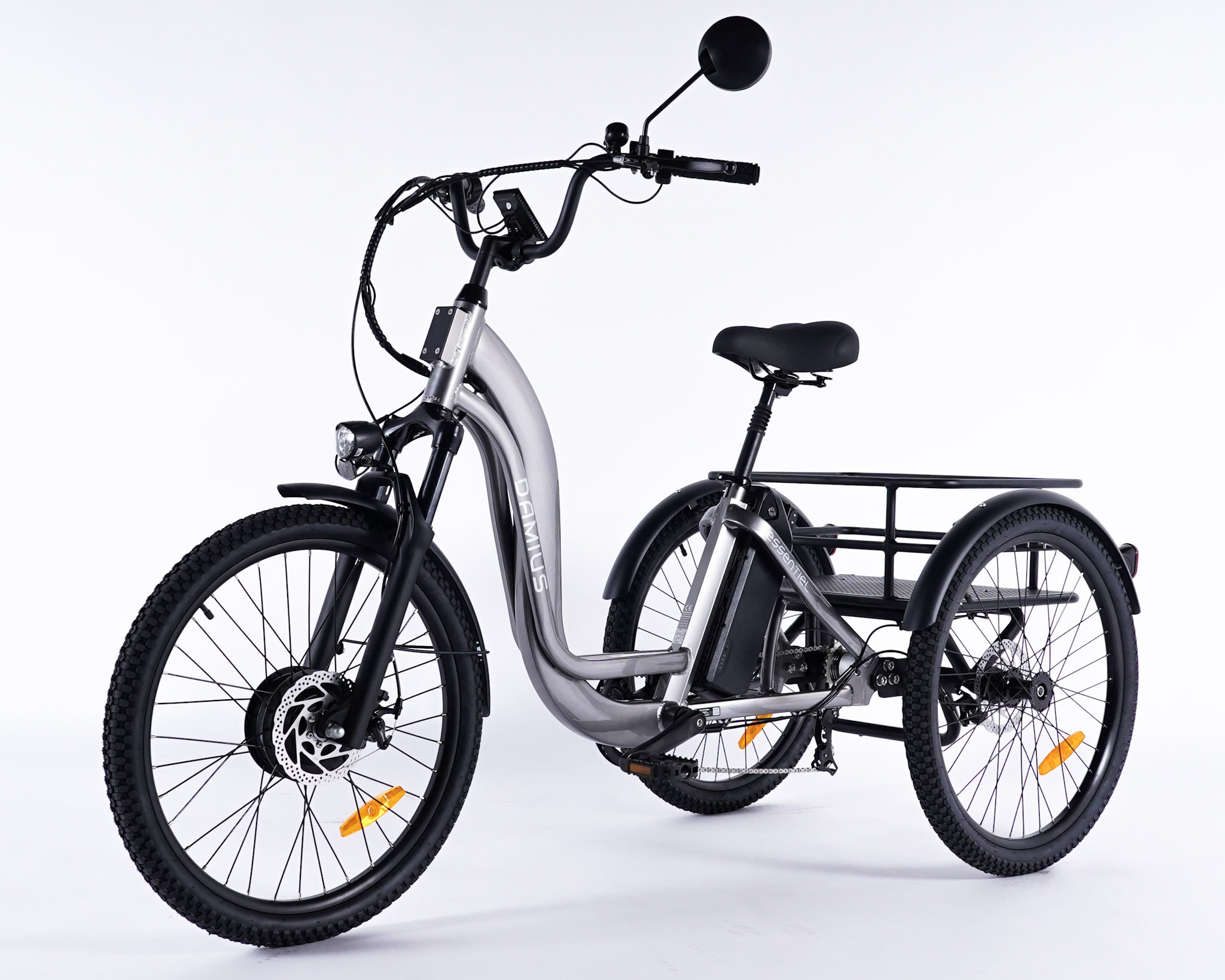
On an Essentiel or an Evasion, the seating remains normal and pedalling is downward, as on a classic bicycle. This is a deliberate choice: it generally makes it easier to stand up on your own, provides good pedalling efficiency, and keeps familiar reference points for someone coming from a two-wheeled bike.
Which choice if standing up on your own is important
For someone who is still independent but fears losing balance, the normal position on a Damius generally makes getting on and off easier. For someone who already has difficulty standing on the pedals or maintaining static balance, a low seat with a backrest can provide a level of security that the classic position does not. In both cases, a test ride remains the only way to decide.
Which is more stable?
Having three wheels is not enough to guarantee stability. On a low-seat tricycle, the centre of gravity is genuinely closer to the ground, which reduces the risk of tipping in corners taken too fast. On a normal-position tricycle like a Damius, stability mainly comes from the track width, the differential that distributes power between the two rear wheels in turns, and a centre of gravity controlled by the frame design. The common point for both families is the same warning: a tricycle does not behave like a bicycle, it does not lean into corners, and you must slow down more than you think before a U-turn or a tight bend.
Comfort: traditional saddle or seat with backrest
Low-seat tricycles provide lumbar and lateral support that the classic position cannot replicate. This is a real advantage for someone who experiences back pain when sitting upright for long periods. Conversely, the Damius position, with a suspended saddle and adjustable handlebars, is better suited to someone who comes from cycling and wants to regain similar sensations without radically changing the way they pedal. Neither position is inherently better; they meet different needs.
Weight and size: a real criterion before buying
The weight of an electric tricycle changes many day-to-day things, from loading it into a car boot to simply pushing it by hand with the battery switched off.
| Model | Length | Width | Weight with battery |
|---|---|---|---|
| Damius ESSENTIEL | 180 cm | 75 cm | around 32 kg |
| Classic Dutch tricycle | around 180 cm | around 75 cm | around 40 kg |
| Dutch low-seat tricycle | around 225 cm | around 78 cm | around 50-60 kg |
A lighter tricycle fits more easily through a narrow garage door, is easier to manoeuvre in a garden shed, and can be pushed by hand without excessive effort if the battery is flat. A low-seat tricycle, longer and heavier, generally requires more generous storage space and a ramp to load it into a van.
Range: figures that cannot be compared directly
The ranges announced by manufacturers depend on terrain, rider weight, wind, temperature and the assistance level selected. They provide an order of magnitude, not a guarantee.
On the Essentiel, the standard 417 Wh battery provides around 40 km, and an optional 720 Wh battery increases this range to around 70-80 km. On Dutch low-seat tricycles, manufacturers generally claim an average of around 50 km with the standard battery, with a wide range depending on conditions, often between 30 and 90 km. The most useful figure is the battery capacity in Wh rather than the displayed mileage, as it is easier to compare from one model to another. As a rule of thumb, you can use 100 Wh of battery capacity for 10 km on a tricycle.
Carrying groceries
The rear basket is standard on Damius tricycles, with a capacity designed for everyday use, and an optional 110-litre cargo box is available, compatible with the brand’s current models. Dutch tricycles also offer baskets and platforms, but often as options and to be fitted separately depending on the chosen configuration. For someone whose main use is grocery shopping or going out with a pet, the integrated basket makes a real difference at the time of purchase.
What about riding uphill?
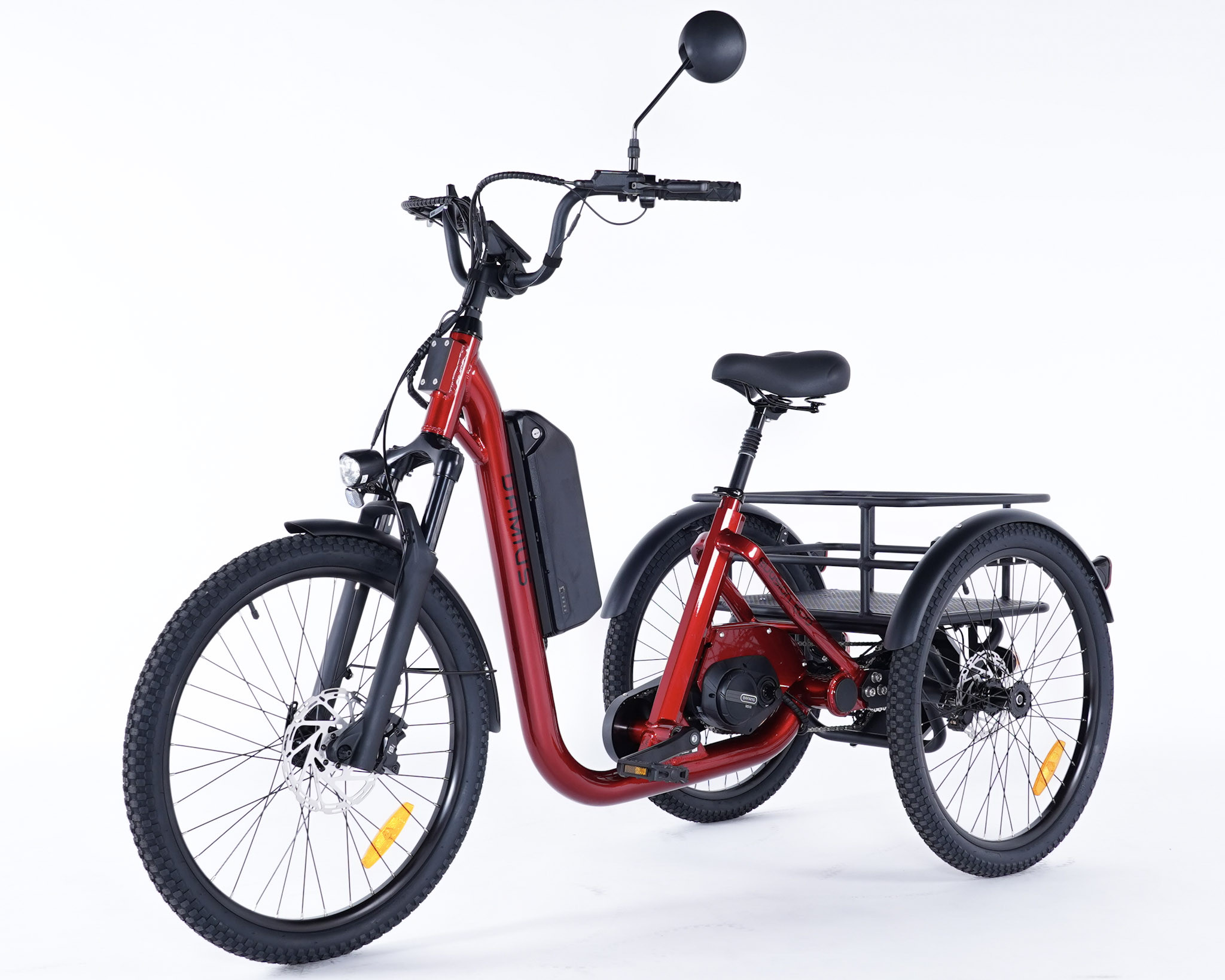
A powerful motor is not enough to climb well; torque and gearing matter just as much. A mid-drive motor, positioned at the crankset rather than in a wheel, transmits its power through the bike’s gears, which helps on steep gradients. This is the choice made on the Evasion Evo, equipped with a 95 Nm Bafang M510 mid-drive motor with automatic gear shifting, designed for hilly terrain without making riding more complex.
Maintenance and after-sales service: a real difference
Dutch tricycles are generally sold through a network of dealers and partner shops. This is convenient if a dealer is near you, less practical otherwise. At Damius, delivery is to your home, the tricycle arrives assembled, adjusted and tested, and after-sales service is managed directly from Miramas by the same team that oversaw manufacturing. Before buying any tricycle, it is worth checking the real availability of spare parts and the average repair time—information that few product pages state clearly.
Why do some Dutch tricycles cost more?
Price does not say everything, but it can be explained. A seat with an adjustable backrest, frame suspension, and highly customised manufacturing based on the rider’s body shape and disability all have a real cost. The most advanced models regularly exceed €7,000 to €8,000 incl. VAT, compared with €2,490 to €3,790 for the current Damius electric range. This does not mean a cheaper tricycle is lower quality, nor that a more expensive tricycle is always justified for everyday use. It mainly means the two products do not start from the same need. At Damius, the aim is to offer a complete range of quality tricycles that cover as many needs as possible.
Which tricycle for your profile
| Your situation | Recommended option |
|---|---|
| I want a position close to a traditional bicycle | Damius Essentiel or Evasion |
| I need a seat with a backrest and a very low centre of gravity | Dutch low-seat tricycle |
| I want to limit weight and overall size | Damius |
| I am looking for a controlled budget | Damius |
| My main use is grocery shopping | All Damius models |
| I want after-sales service directly in France | Damius |
| I ride on very hilly terrain | Damius Evasion Evo, 95 Nm mid-drive motor |
What you should test before buying, whatever the model
A real-world test ride remains the best way to decide. This means getting on and off the tricycle on your own without help, making a tight U-turn and several low-speed turns, starting uphill and braking hard, using the parking brake, moving the tricycle with the motor off to feel its real weight, then loading a few groceries into the basket to check access and balance. It is also worth measuring in advance the width of your garage door, the available storage space and, if applicable, the space in a car boot.
Key takeaway
A Dutch tricycle is not automatically better than a Damius tricycle; they are two different philosophies. The first prioritises advanced ergonomic customisation, at the cost of higher weight and a higher budget. The second prioritises simple everyday use, controlled weight and French support, at a much more accessible price. Comparing a Damius tricycle with a specific Dutch model, rather than with the entire category, remains the only way to make an informed choice.
Need advice choosing your electric tricycle?
|
Frequently Asked Questions
Is a Dutch tricycle more stable than a Damius tricycle?
Not necessarily. A low-seat tricycle lowers the centre of gravity, which helps in corners, but a Damius remains stable thanks to its track width and differential. Neither behaves like a bicycle, and a test ride remains essential in both cases.
Why are Dutch low-seat tricycles more expensive?
Their design includes a seat with an adjustable backrest, frame suspension and often customised manufacturing based on the user’s body shape, which increases production costs compared with a standard design.
Which electric tricycle should an active senior choose?
For someone who is still independent and wants a familiar, bike-like position, an Essentiel or an Evasion covers most everyday uses, including grocery shopping thanks to the standard basket.
Which tricycle should you choose if you have balance difficulties?
If the difficulties are mild, the normal position and differential on a Damius are often sufficient. In cases of more pronounced static balance issues, a low seat with a backrest can provide additional support, to be assessed with a test ride and, if needed, medical advice.
Does Damius manufacture its tricycles in France?
Design, final assembly, quality checks and after-sales service are carried out in Miramas. Since late 2025, part of the parts manufacturing has been outsourced, but design, final assembly and follow-up remain French.
Do you need registration for a Damius tricycle?
No. All current models comply with standard e-bike regulations: 250 W and assistance limited to 25 km/h, with no registration or specific equipment, unlike quadricycles or L2e-category models.


