

A standard bike rack is almost never suitable for an adult tricycle. The width between the rear wheels, the tricycle’s actual weight, and the frame geometry completely change the equation. Here is how to check compatibility between your tricycle, your tricycle carrier, and your car before setting off.
Key takeaways
To transport an adult tricycle, a dedicated towbar-mounted platform is almost always the most suitable solution. A standard bike rack may sometimes show a sufficient load rating in kilos, but the spacing of its rails and the way it secures the frame are not suitable for three wheels. Three limits must be respected together: the vehicle’s, the towbar’s, and the tricycle carrier’s. It is always the lowest of the three that applies.
Can you transport a tricycle on a standard bike rack?
Why three wheels completely change the way it is secured
A standard bike rack is designed for two aligned wheels and a narrow frame. A tricycle has a wide rear track, a longer wheelbase, and a frame shape that does not lend itself to the same attachment points.
Width of the two rear wheels
This is often the first obstacle: the spacing of the two rear wheels is far greater than that of two rails on standard bike racks.
Wheelbase and overall length
An adult tricycle is significantly longer than a bicycle, which creates a rear overhang issue at the back of the vehicle and makes it harder to stay within legal road dimensions.
Weight of an electric tricycle
Battery and motor can easily add 10 to 15 kilos compared with a non-electric model, a factor that directly affects the choice of carrier.
Why two bike rails are usually not enough
A common misconception comes up often: a bike rack rated for 60 kilos should carry a 35-kilo tricycle without any issue. In most cases, this is false. The load rating in kilos is only one criterion among others. Rail spacing, how the frame is secured, and how the weight is distributed across the structure matter just as much, and a standard bike rack is simply not designed for these constraints.
Which tricycle carrier should you choose for a car?
| Solution | Adult tricycle | Electric tricycle | Ease of loading |
| Standard bike rack | Rarely suitable | Often no | Average |
| Towbar-mounted tricycle platform | Yes | Yes, depending on load | Good |
| Cargo carrier with adaptation | Possible | Possible | Variable |
| Transport in the boot | Folding models | Depending on weight | Variable |
| Small trailer | Yes | Yes | Very good |
The towbar-mounted tricycle carrier: the most practical solution?
How does a tricycle platform work?
The principle is similar to a standard towbar-mounted bike rack, but the platform is wider and the rails are spaced to accommodate a tricycle’s rear track width. Unfortunately, these platforms are only available for motorhomes with a specific mounting system.
Mounting on the tow ball
The carrier attaches directly to the vehicle’s tow ball, which means it must be approved for the corresponding vertical nose weight.
Three rails or a large platform?
Some carriers offer three independent rails for the three wheels; others use a continuous platform that is easier to load but can be bulkier when folded.
Straps and frame retention
The wheels alone are never enough to immobilise a tricycle. The frame must be strapped separately to prevent any lateral movement during the journey.
Locking the carrier and the tricycle
An electric tricycle represents a significant value. A locking system for the carrier, combined with a lock for the tricycle itself, remains a useful precaution during longer stops.
How do I know whether a tricycle carrier is compatible with my tricycle?
This is the most important question before any purchase, and the one most product sheets address the least.
Measure the tricycle’s overall width
Measure at the widest point, including the wheels, to know the true footprint once loaded.
Measure the track width of the two rear wheels
This is the most decisive measurement for checking compatibility with the spacing of the tricycle carrier’s rails. Measure from the centre of one tyre to the centre of the other.
Measure the wheelbase
The distance between the front axle and the rear axle determines the platform length required.
Check tyre width
Wide tyres may not sit properly in rails designed for standard bicycle tyres.
Weigh the tricycle
The exact weight, with or without the battery depending on what will actually be transported, is the baseline for all load calculations.
Check the frame shape
A low step-through frame, a rear basket, or a cargo structure can interfere with strap placement or conflict with certain parts of the carrier.
Four measurements are enough to document compatibility before purchase: overall length, overall width, the distance between the rear wheels, and the wheelbase. Writing them down precisely before comparing the technical specifications of different carriers avoids the vast majority of unpleasant surprises.
How much load can a tricycle carrier support?
Weight of a standard tricycle
A non-electric tricycle generally weighs between 20 and 30 kilos, depending on the model and equipment.
Weight of an electric tricycle
Motor and battery often add 10 to 15 kilos, bringing the total above 35 or 40 kilos for many models, or even more.
Battery fitted or removed?
Removing the battery before transport reduces total weight and makes loading easier, provided the model allows it easily. It is also preferable from a safety standpoint, to prevent the battery from falling during the journey.
Maximum load of the tricycle carrier
This information is listed on the carrier’s technical sheet and must always exceed the tricycle’s actual weight, with a reasonable safety margin.
Maximum vertical nose weight of the towbar
This is the most frequently overlooked point. The full calculation adds the weight of the tricycle carrier itself and the loaded tricycle. A 19-kilo carrier combined with a 40-kilo tricycle applies 59 kilos to the towbar, not just the tricycle’s 40 kilos. This total load must remain below the maximum vertical nose weight authorised by the vehicle manufacturer.
How do you transport an electric tricycle by car?
Why weight is the main issue
A complete electric tricycle often exceeds 35 kilos, which makes loading difficult—or even risky—for one person without suitable equipment.
Remove the battery before loading
When the model allows it, removing the battery significantly lightens the unit and reduces vibrations affecting a sensitive component during the journey.
Use a ramp rather than lifting the tricycle
Rolling the tricycle up a ramp onto the platform avoids any lifting effort, a precaution that is particularly useful for regular use.
Secure the three wheels separately
Each wheel must be locked individually in its rail before dealing with the frame, to prevent movement while the straps are being fitted.
Immobilise the frame without damaging cables
Straps must go around structural parts of the frame, never electrical cables or brake hoses.
Check that nothing can rotate or come loose
A final visual check before setting off remains the best safeguard against unexpected movement on the road.
Do you need a loading ramp?
Why a ramp is particularly useful for an electric tricycle
It avoids any lifting effort for a vehicle that frequently exceeds 35 kilos, which quickly becomes difficult to carry alone.
Integrated or removable ramp
An integrated ramp is always available but adds weight to the carrier. A removable ramp is stored separately and can be forgotten at the worst time.
What width should you plan for?
The ramp must match the tricycle’s track width to allow stable loading, without the risk of the wheels slipping off the edges.
Beware of platforms that are too high
The higher the platform is from the ground, the steeper the ramp angle, which makes loading harder even with a suitable ramp.
Can you put an electric tricycle in a car boot?
Folding tricycles
Some models designed to fold can fit in a large boot, provided you check the exact dimensions once folded.
Which parts can be removed?
Depending on the model, the front wheel or rear basket can sometimes be removed to gain a few extra centimetres.
Should the wheels be removed?
This is possible on certain tricycles, but the procedure complicates loading and is not supported on all models.
How do you protect the inside of the car?
A tarp or cover prevents grease marks on the boot lining during transport.
Measure the boot before purchase
Comparing the boot dimensions—doors open and rear seats folded if needed—with the folded tricycle dimensions prevents buying a model that ultimately is not compatible.
Tricycle carrier or small trailer: which solution should you choose?
A tricycle carrier is more compact and does not require additional parking space, with installation generally simple on an existing towbar. A trailer is better suited to a tricycle—especially an electric one—and often makes loading easier, since the tricycle rolls directly inside rather than being lifted onto a platform. The choice mainly depends on trip frequency, the tricycle’s actual weight, your ability to store the equipment, and the towbar available on the vehicle.
Can you transport a tricycle on the roof?
This is rarely a realistic solution for an adult tricycle, due to the weight, the width, and the difficulty of lifting it to that height.
Permitted roof load
The maximum authorised load on a car roof is often far below the weight of a complete electric tricycle.
Vehicle height
Lifting a tricycle weighing several dozen kilos up to roof height requires lifting equipment that simply does not exist for this type of vehicle.
Loading difficulty
Without a dedicated lifting system, the operation becomes physically risky for one person.
Aerodynamic drag
The wind resistance of a tricycle on the roof would significantly worsen fuel consumption and vehicle stability at road speeds.
Is a tailgate-mounted tricycle carrier possible?
Why strap-on bike racks are poorly suited
These systems rely on thin straps designed for a light bicycle frame, which are incompatible with the weight and shape of a tricycle.
Tricycle width
A tricycle’s width almost always exceeds what a standard tailgate carrier is designed for.
Load borne by the tailgate
The tailgate itself is not designed to support a suspended load of several dozen kilos over time.
When can a tailgate solution work?
In practice, a tailgate solution is reserved for standard bicycles and is not recommended for an adult tricycle.
What car do you need to transport a tricycle?
City car with towbar
Sufficient if the towbar accepts the required vertical nose weight, even on a small vehicle.
SUV
A large boot is not decisive if transport is on the towbar rather than inside the vehicle.
Estate car
Useful mainly if a folding tricycle is intended to be transported in the boot rather than on an external platform.
MPV
The available interior space can make it easier to transport accessories, a battery, or a protective cover in addition to the tricycle carrier.
Van or utility vehicle
Suitable when several tricycles need to be transported at the same time, especially for professional use.
The key point is not only the size of the vehicle. A small vehicle properly approved for a suitable towbar can prove more practical than a large SUV without a compatible transport system.
How do you check compatibility with your car’s towbar?
Maximum vertical nose weight on the tow ball
This information is shown on the towbar plate or in the vehicle registration document.
Load permitted by the tricycle carrier
Indicated on the carrier’s technical sheet, it must remain compatible with the actual weight of the tricycle being transported.
Towbar type
A detachable or retractable towbar must be correctly locked before each use with a tricycle carrier.
7- or 13-pin electrical compatibility
Required as soon as the carrier includes a light bar or a mounting point for a repeat number plate.
Follow the car manufacturer’s instructions
Three limits must be respected simultaneously: the vehicle’s, the towbar’s, and the tricycle carrier’s. It is always the lowest of the three that determines what is actually permitted.
Number plate and lights: which rules must be followed?
Does the number plate need to remain visible?
Yes, the vehicle’s number plate must never be obscured by the tricycle or the carrier once loaded.
When is a repeat number plate required?
As soon as the load obscures the original plate, a compliant repeat number plate must be fitted to the carrier.
Rear lights and indicators
The vehicle’s lights must not be obscured either, otherwise they must be replicated on the carrier.
Why platforms often have a light bar
This is precisely to meet this requirement: many platforms include a light bar and a plate holder, rather than leaving vehicle visibility dependent on the load.
Watch the tricycle’s width behind the car
Measure the tricycle once loaded
The effective width at the rear of the vehicle may exceed the width of the car itself once the tricycle is in place.
Risk of lateral overhang
Any overhang must be signalled in accordance with the regulations in force, as with any load that exceeds the vehicle’s overall dimensions.
Manoeuvres and parking
Reversing manoeuvres become more delicate with a loaded tricycle, especially in a confined space.
Tolls, car parks, and narrow passages
The additional width can cause issues in certain narrow passages or car parks with automatic barriers.
Visibility in the mirrors
A loaded tricycle can block part of the rear field of view, which justifies extra caution when changing lanes.
How do you properly secure a tricycle on the tricycle carrier?
| Step | Action |
| 1 | Place the three wheels in their rails |
| 2 | Lock each wheel individually |
| 3 | Immobilise the frame with the provided straps |
| 4 | Check the tension of each strap |
| 5 | Check the number plate and lighting |
| 6 | Test the setup before driving off |
| 7 | Check the fastenings after the first few kilometres |
Which solution for a reduced-mobility (PRM) tricycle?
Make loading easier
A low platform and a suitable ramp significantly reduce the physical effort required for loading.
Prioritise a ramp
It avoids any lifting and can allow loading independently—or with limited assistance—depending on the person’s mobility.
Avoid having to lift the tricycle
A tricycle adapted for people with reduced mobility is often heavier and wider than a standard model, making manual lifting unrealistic.
Check the platform’s real capacity
A PRM tricycle can significantly exceed the weight and dimensions of a standard city tricycle, which must be checked before purchasing any carrier.
Which solution for a recumbent tricycle?
Greater width and length
A recumbent tricycle often has greater width and length than a standard upright tricycle.
Different wheelbase
The rider’s reclined position implies a longer wheelbase, which should be checked precisely before choosing a carrier.
Tadpole or delta tricycle
A tadpole has two wheels at the front and one at the rear; a delta is the opposite. Weight distribution on the carrier is not the same depending on the configuration.
Folding or partially dismantlable model
Some recumbent tricycles fold or partially dismantle, which may allow transport in the boot rather than on an external tricycle carrier.
How much does a car tricycle carrier cost?
Adapting an existing bike rack
Sometimes economical, but rarely advisable given the limitations already mentioned regarding rail spacing and frame retention.
Specialised towbar-mounted platform
This is the most suitable category for regular use, with pricing that reflects tricycle-specific design.
Heavy-duty cargo carrier
A robust, more expensive option designed for varied loads, sometimes including tricycles or similar vehicles.
Trailer
A solution that is not necessarily much more expensive to buy, but that simplifies loading for a particularly heavy or bulky tricycle and can be used for purposes other than transporting a tricycle.
What to check before buying a tricycle carrier
| No. | Criterion |
| 1 | Exact tricycle weight |
| 2 | Weight of the tricycle carrier itself |
| 3 | Towbar vertical nose weight |
| 4 | Tricycle width |
| 5 | Rear wheel track width |
| 6 | Wheelbase |
| 7 | Tyre width |
| 8 | Ramp included |
| 9 | Locking system |
| 10 | Integrated plate holder and lights |
| 11 | Boot access once the carrier is installed |
| 12 | Overall compatibility with the vehicle |
Damius tricycles and transport by car
Damius tricycles include a differential as standard and a motor system compliant with electric-assist bicycle regulations, placing them in the same general ranges of weight and width as the models discussed in this article. Before purchasing any tricycle carrier, the Damius team in Miramas can provide the exact dimensions and weight of the model concerned, with or without the battery, to check compatibility with a given carrier or towbar.
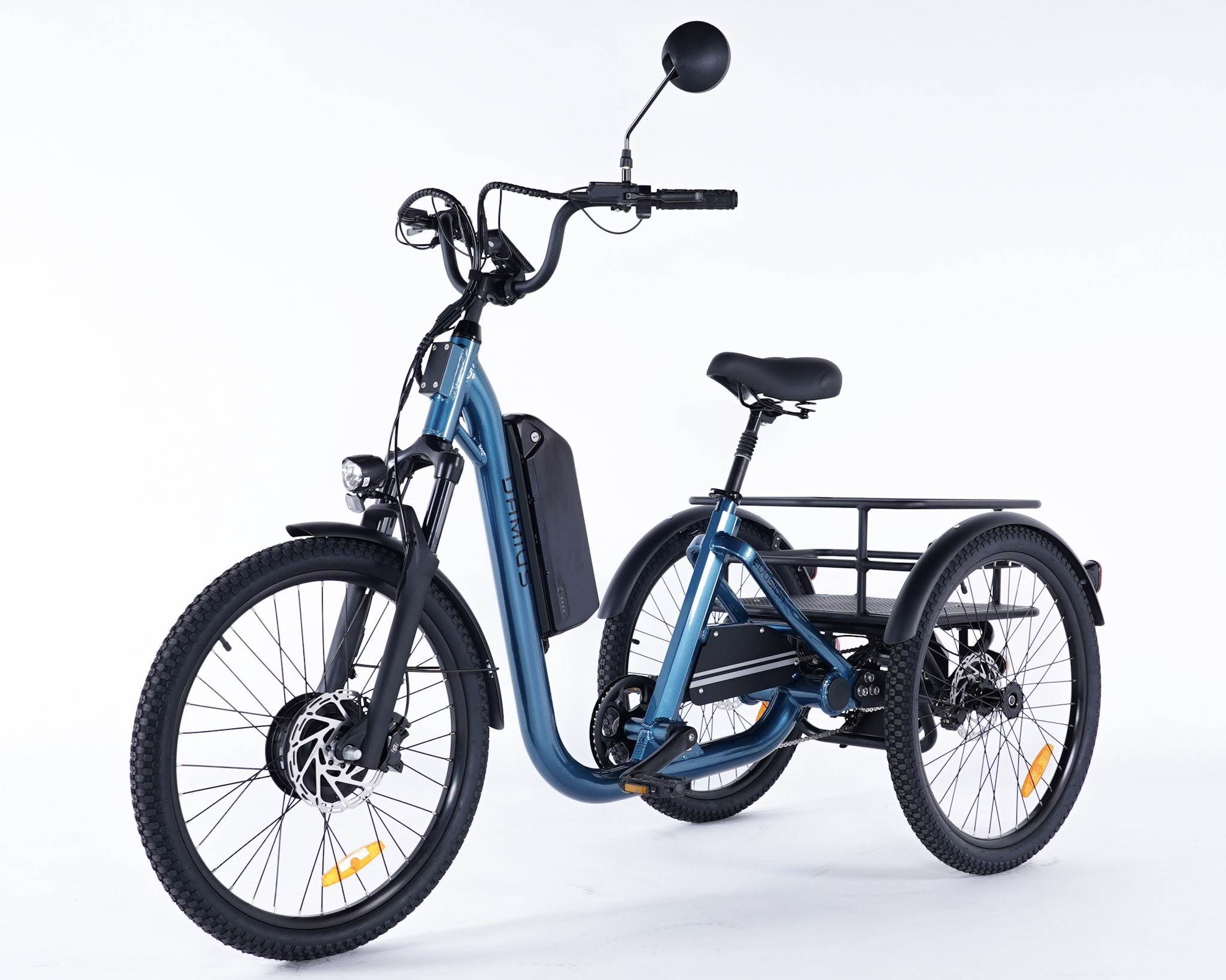 | Evasion — €2,990 Damius’s best-selling model since 2016. Standard differential, hub motor. Contact the team to find out the exact weight and the dimensions needed to choose a tricycle carrier. |
FAQ on transporting a tricycle by car
Is there a bike rack for an adult tricycle?
Yes, there are platforms specifically designed for tricycles, with wider-spaced rails and a suitable maximum load, but they are very rare and difficult to obtain. A standard bike rack, however, is generally not suitable.
How do you transport an electric tricycle by car?
On a suitable towbar-mounted platform, ideally with a loading ramp to avoid lifting the tricycle’s weight. Removing the battery before loading lightens the unit and protects this component.
Can you put a tricycle on a bike rack?
Rarely in a satisfactory way. Rail spacing and the frame fastening method generally do not match a tricycle’s geometry, even when the load rating in kilos seems sufficient.
Which bike rack for an electric tricycle?
A specialised towbar-mounted tricycle platform whose maximum load clearly exceeds the tricycle’s actual weight with its battery.
Can you transport a tricycle on a tow ball?
Yes, provided the total vertical nose weight, including both the tricycle carrier and the tricycle, remains below the maximum load authorised by the vehicle for that tow ball.
How do you transport a folding tricycle?
Depending on its dimensions once folded, it can fit in the boot of an estate car or an MPV. It remains essential to check the folded dimensions against the boot dimensions before purchase.
Does a tricycle fit in a car boot?
Only folding models, and only if the folded dimensions truly match the available boot space.
How much load can a tow ball support?
This value is specific to each vehicle and is shown on the towbar plate or in the vehicle registration document. It varies greatly from one car model to another.
Can you transport a tricycle on the roof?
This is generally not realistic, due to the weight to be lifted, the tricycle’s width, and the lack of a lifting system suitable for this type of vehicle.
Is there a tricycle carrier with a ramp?
Yes, some platforms include a fixed or removable ramp, particularly useful to avoid lifting a heavy electric tricycle.
How do you transport a PRM tricycle?
Preferably on a low platform equipped with a ramp, avoiding any manual lifting, and checking that the carrier’s capacity matches the often higher weight of this type of tricycle.
How do you transport a recumbent tricycle?
By taking into account its width and wheelbase, which are often greater than those of a standard upright tricycle. A folding or dismantlable model may allow transport in the boot rather than on an external carrier.
Editorial note: towbar specifications vary by vehicle. You should always check the car manufacturer’s guidance before purchasing any transport carrier.


