
For someone with significant balance issues, the most reassuring choice is generally a tricycle with a low center of gravity, an easy step-through frame, and a stable seat. If fatigue or hills make outings difficult, well-calibrated electric assistance can make all the difference. However, three wheels alone do not guarantee the same stability: seat height, tricycle width, cornering behavior, and braking ease matter just as much.
Key takeaway
Do not simply look for a three-wheeled tricycle: look for geometry suited to your balance. Seat height, frame width, and cornering behavior are just as important as motor power or battery range. At Damius, each model is designed to meet these requirements precisely.
Which type of tricycle for your situation?
Before looking at models, it is best to start with your own situation. Each profile has different needs, and the right tricycle is not the same depending on whether you feel slight apprehension when starting off or have major difficulty maintaining your balance.
| Situation | What to prioritize | Why |
|---|---|---|
| Apprehension mainly when starting and stopping | Low step-through tricycle | Stays stable when stopped; no need to put a foot on the ground |
| Severely reduced balance, fear of falling | Seat with backrest, wide frame | Lower center of gravity, supportive and reassuring seating |
| Balance difficulties and quick fatigue | Electric tricycle with progressive assistance | Reduces effort without destabilizing you when starting |
| Difficulty lifting the leg (hip, knee) | Very low step-through frame | Easy mounting and dismounting with no effort or risk of losing balance |
| Shopping or transport needs | Tricycle with rear trunk or basket option | Practical without changing your balance or posture |
Is an adult tricycle really more stable than a bicycle?
Why three wheels make starting and stopping easier
The main difference, and often the most appreciated, is simple: with a tricycle, you do not need to put your foot on the ground as soon as you stop. The tricycle stands upright on its own. This changes a lot for someone who fears stops, slowdowns, or hill starts. At very low speed—where a bicycle becomes unstable and requires constant attention—the tricycle remains steady.
This is exactly what reassures most people who take the plunge. Gilles, 71, puts it well: after a fall while stopped, he no longer felt confident on his bicycle. With his Damius Essentiel, he rediscovered the pleasure of pedaling without apprehension, including in the small village streets where he often has to stop.
Stable when stopped does not mean impossible to tip over
This is an important point that buying guides rarely mention. An adult tricycle does not ride exactly like a bicycle, and you should know this before buying. In a straight line and at a moderate pace, stability is remarkable. But in turns, on a cambered road, or at too high a speed, the behavior changes and the ride may not feel very natural. A tricycle does not naturally lean into corners the way a bicycle does. You therefore need to slow down before changing direction, especially during the first few weeks.
Static stability ≠ dynamic stability
A tricycle is stable when stopped and at low speed. However, in fast turns or on sloped ground, you must adapt your riding and your speed. This is the guiding principle to keep in mind throughout the process of choosing a tricycle: look for geometry that matches your riding style.
The most important criteria for choosing a tricycle when you lack balance
1. Prioritize a low center of gravity
This is the criterion that is often mentioned last but should come first. The lower the seat, the lower the center of gravity, and the more stable the tricycle feels. This rule applies when stopped, but even more so when moving. High-saddle tricycles, closer to a traditional bicycle, may feel familiar, but their higher center of gravity makes them more sensitive to camber and tighter turns.
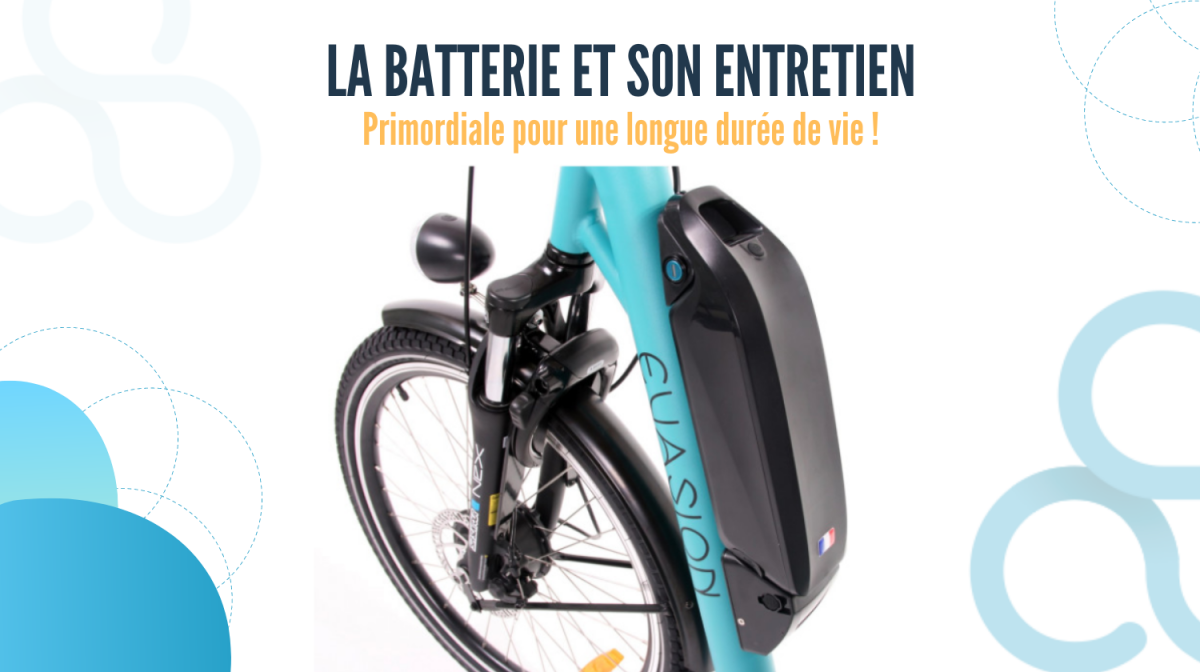
At Damius, frame design takes into account this balance between seat height and overall chassis stability. All models are designed around the most ergonomic riding position possible, with a lowered center of gravity and as much weight as possible resting on the rear wheels to maximize stability. The Evasion Evo, for example, with its 95 Nm mid-drive motor, is intended for users who want a tricycle that is both robust and precise, without sacrificing accessibility.
2. Check the step-through height
Getting on and off the tricycle without effort, without fearing a few seconds of instability: this is often where confidence in the vehicle is gained or lost. A frame with too high a step-through requires lifting the leg, which can be an issue if you have hip or knee stiffness. Damius tricycles are designed with low frames for easier access, including for people with reduced mobility.
3. Consider width and wheelbase
A wider tricycle is generally more stable, but it is also bulkier. Before buying, it is worth measuring the width of your gate, your garage, or the storage area where the tricycle will be kept. Some passages are too narrow for the widest models. Maneuverability also depends on it: a very wide tricycle is harder to turn around in a hallway or in a parking lot.
4. Choose a seat suited to the support you need
A traditional saddle suits someone who is comfortable with a bicycle riding position and has good core stability. For those who need a bit more support, a seat with a backrest provides real comfort and a greater sense of security. The position is then lower, the pelvis is well supported, and back fatigue decreases over longer distances. It is a difference you feel from the very first test ride.
5. Check braking and the parking brake
Easy-to-operate brakes are essential, especially if hand strength is limited. Disc brakes provide greater stopping power with less lever effort, which people with arthritis appreciate immediately. A parking brake is also useful for stops on slopes or when you need to get off the tricycle without it moving. On the Damius Essentiel, Evasion, and Evasion Evo models, mechanical disc brakes are standard.
6. Assess how the assistance behaves when starting
This is a point that almost no buying guide addresses. Electric assistance that delivers strong power from the first pedal stroke can destabilize someone who already lacks confidence. Ideally, power should build progressively, supporting pedaling rather than getting ahead of it. At Damius, the assistance is particularly well designed, adjustable, and follows the rider’s cadence, making it very well suited to people who need to regain confidence on three wheels.
7. Do not forget weight and storage
An electric tricycle generally weighs between 35 and 50 kg. This makes little difference while riding, but it matters a great deal when you need to move it by hand, store it in a shed, or load it into a vehicle. Check the total weight of the model you are considering, as well as its dimensions: length, width, and whether it can be stored at ground level or if steps must be negotiated.
Traditional tricycle or comfort-seat tricycle: which should you choose?
The tricycle with two rear wheels
This is the most common configuration and the closest to a traditional bicycle. Easy to get used to, it suits those with mild apprehension who want to rediscover the pleasure of pedaling without changing their habits too much. The saddle is often higher, which places the center of gravity slightly above that of a low-seat tricycle. This is perfectly acceptable for most uses.
The Damius Essentiel (€2,490) and Essentiel Fatbike (€2,690) models fall into this category. They come with a differential as standard, which significantly improves stability in turns by allowing the two rear wheels to rotate at different speeds. It is a technical detail that truly changes everyday riding.
The more comfortable seated tricycle
For someone for whom balance is the dominant criterion, a lower, more supportive seat may be the best option. It lowers the center of gravity, provides better pelvic support, and delivers a reassuring sense of stability, even at low speed. If core support is an issue, a seat with a backrest is a genuinely practical solution, not a gimmick.
Evasion tricycles: when hills come into play
The Evasion (€2,990) and Evasion Evo (€3,790) models are designed for more demanding use: varied terrain, longer rides, elevation changes. The Evasion Evo features a 95 Nm mid-drive motor with an automatic gearbox, hydraulic disc brakes, an integrated lock, and a color display. For someone who wants to resume regular physical activity despite balance issues and reduced fitness, this model offers a significant comfort margin.
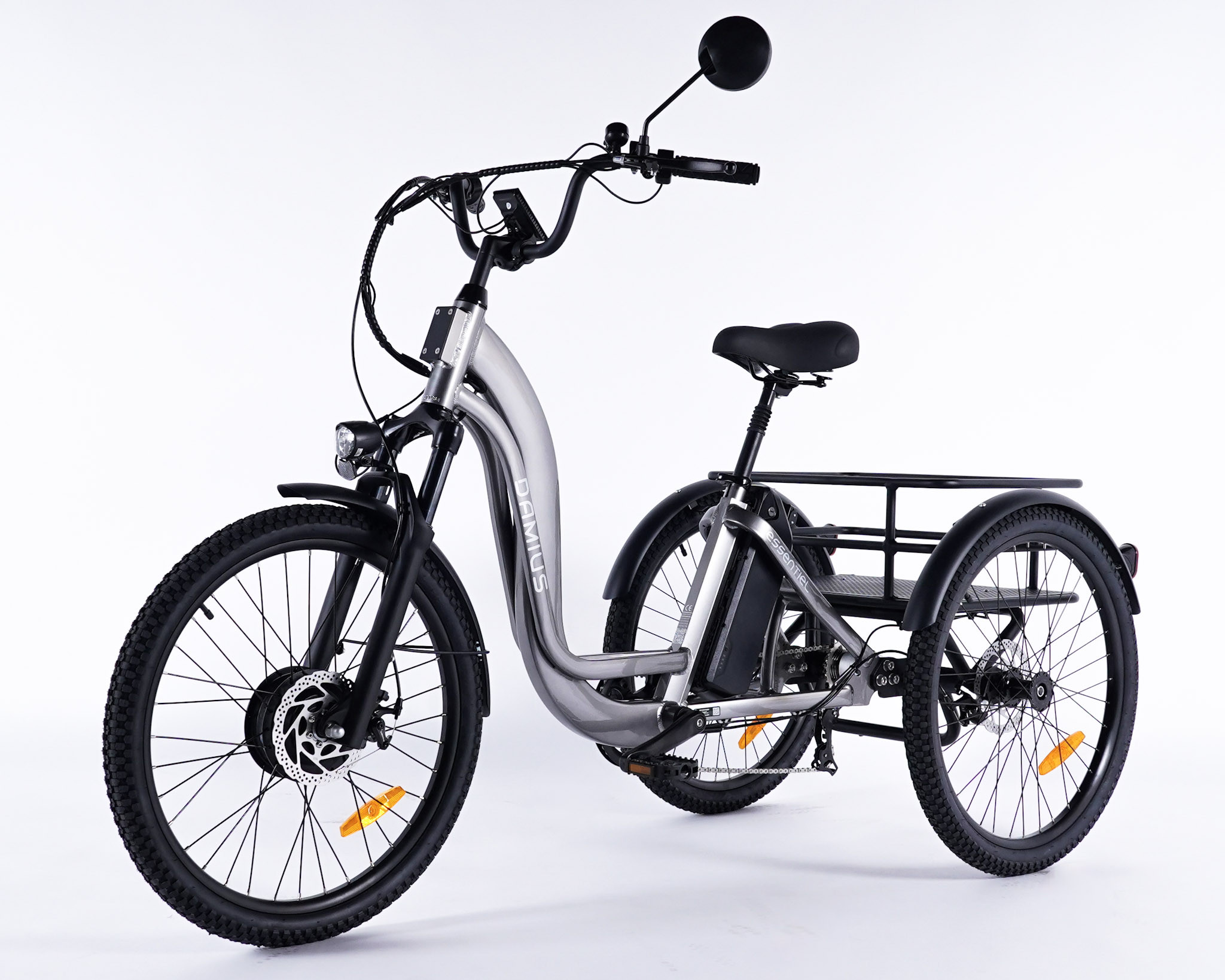
Damius Essentiel — €2,490
The entry point of the range, designed for people who want to regain the freedom to pedal without fear. 250W motor, progressive assistance, differential as standard, low step-through 36 cm. A reliable all-road tricycle for everyday trips.
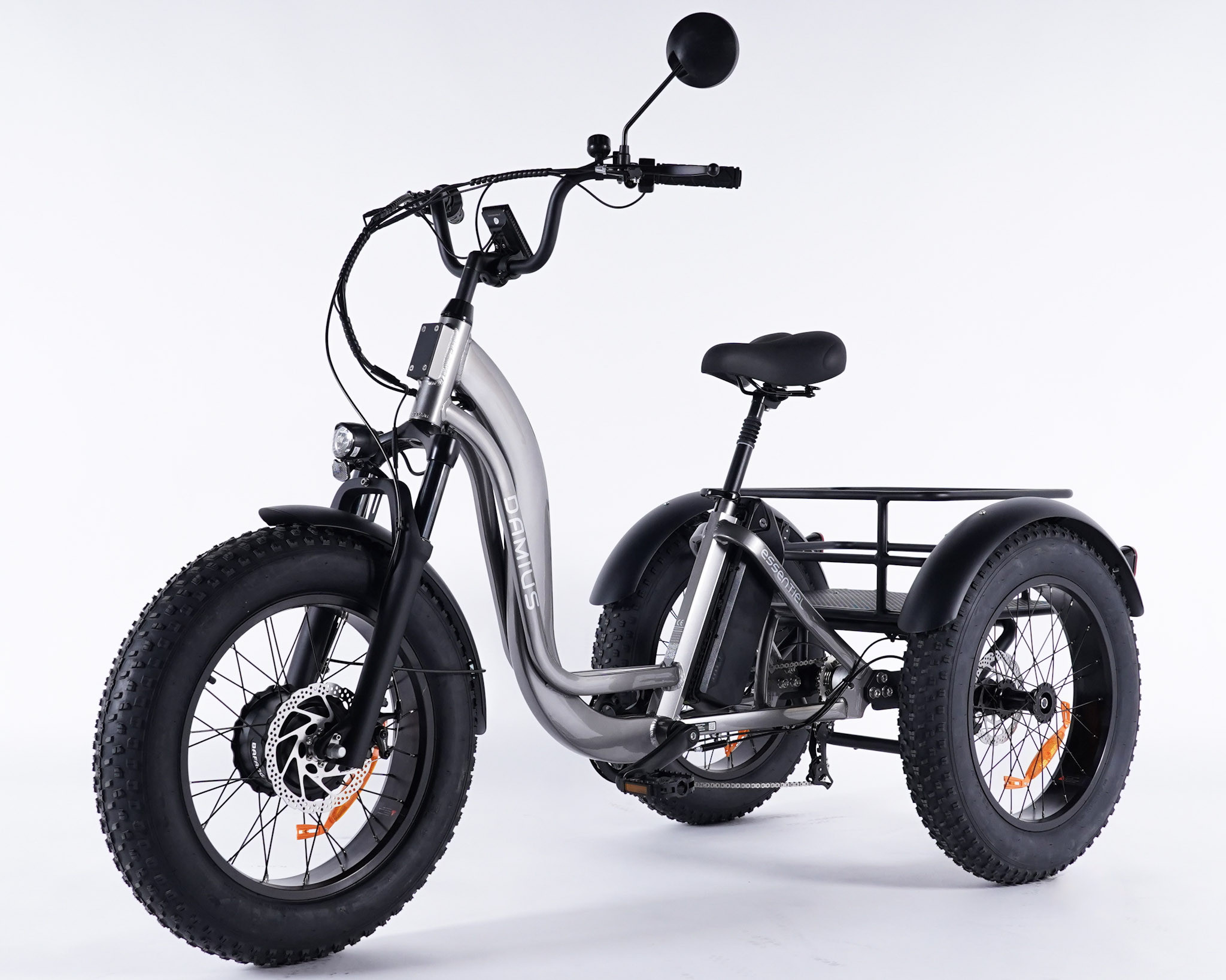
Damius Essentiel Fatbike — €2,690
The same strengths as the Essentiel, with wide tires that better absorb uneven ground and increase the contact patch. An advantage on rougher paths or unstable surfaces.
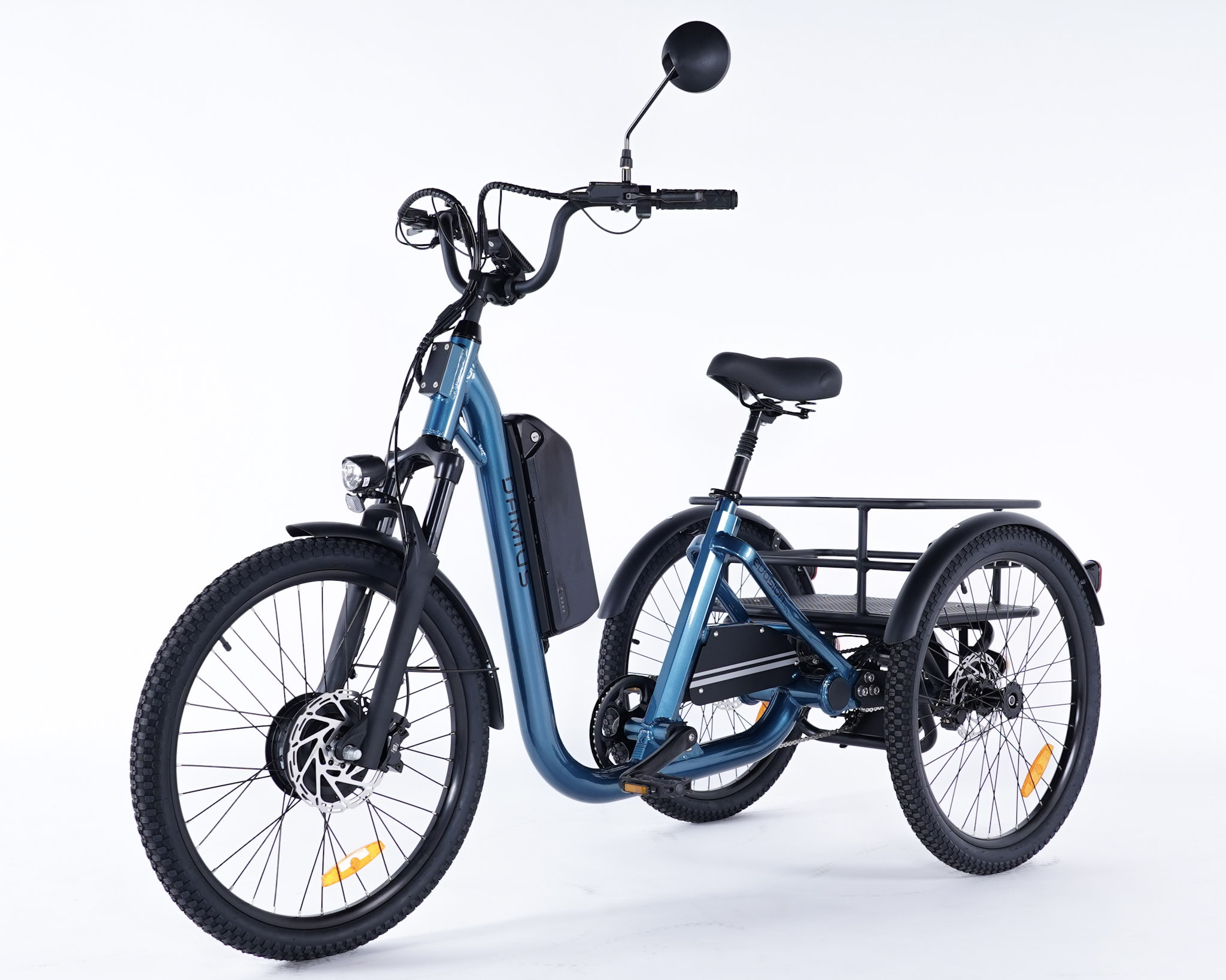
Damius Evasion — €2,990
For those who want to go further, on varied terrain and over longer distances. Robust frame, adjustable assistance, differential as standard, Nexus derailleur, hydraulic disc brakes, turn signals, integrated lock, color display. A tricycle designed to support a gradual return to activity over time.
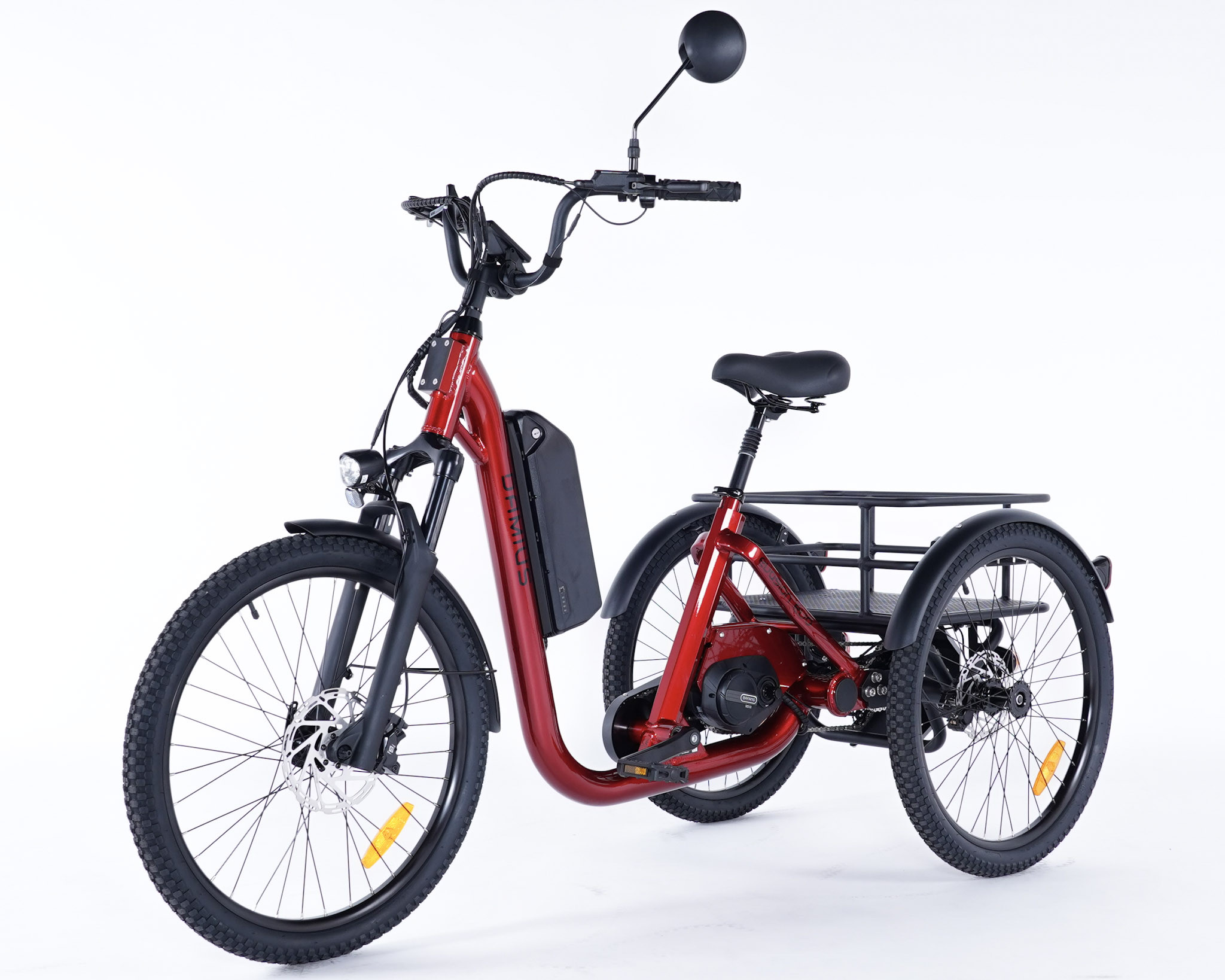
Damius Evasion Evo — €3,790
The most complete model in the range. 95 Nm mid-drive motor, automatic gearbox, hydraulic disc brakes, turn signals, integrated lock, color display. For someone who wants a fully developed machine capable of anything, with riding comfort on par with a vehicle designed down to the smallest detail.
Should you choose an electric tricycle if you have balance problems?
Electric assistance helps you move forward. It does not change the chassis geometry, seat height, or cornering behavior. Stating this upfront avoids a common mistake: believing that an electric tricycle is automatically more stable than a model without assistance.
What it does provide, however, is real: it reduces effort on hills, allows longer rides without fatigue, and makes restarting after a stop easier. For someone whose balance difficulties are linked to muscular fatigue, or who rides in a somewhat hilly area, it is a practical aid that changes the experience.
| Without assistance | With electric assistance |
|---|---|
| Very short trips on flat ground | Hills and elevation changes without excessive effort |
| Lower budget, simpler maintenance | Longer rides, reduced fatigue |
| Sufficient physical capacity to pedal | No difficulty restarting the tricycle after a stop |
All Damius electric models comply with current EPAC regulations: 250W motor, assistance cuts out above 25 km/h, pedaling required. This means no registration or specific insurance is required, unlike tricycles with combustion engines or mopeds.
How can you test a tricycle before buying?
A test ride is essential. Reading model descriptions provides reference points, but nothing replaces fifteen minutes on the tricycle itself. A few points to check systematically:
Start by getting on and off the tricycle several times. This is often where you notice a step-through that is too high or a poorly positioned seat. Then start off gently and ride very slowly: this is the real low-speed stability test. Next, do a few complete stops, turn right and left, and try a U-turn in a confined space. Apply the brakes several times to assess the effort required. Finally, move the tricycle by hand to simulate storage or taking it out of the garage.
After this test, you should be able to answer these questions honestly: do I feel confident? Are mounting and dismounting easy? Do the brakes respond easily? Can I maneuver without stress in a confined space?
Damius offers test rides at its partner retail locations or directly at home (subject to conditions). Mathis and Charly, our sales advisors, can direct you to the nearest distributor and support you in this choice. Please feel free to contact them on 04 90 59 49 10 or by email at info@damius.com.
Mistakes to avoid when choosing a tricycle for balance problems
Thinking all tricycles are equally stable
A three-wheel configuration guarantees stability when stopped, but seat height, center of gravity, riding position, frame width, and whether or not there is a differential make a real difference in real-world conditions.
Choosing based on price alone
A low-cost model may be suitable, but if its seat height or cornering behavior does not match your needs, the result will be disappointing. Price is one criterion among others, not the first.
Buying without testing
Photos and technical sheets provide only a partial idea. The feel in the saddle, how easy it is to get on and off, and brake response: all of this must be verified in a test ride, not on a screen.
Choosing electric assistance that is too abrupt
Assistance that starts strongly can surprise and destabilize. Ideally, power should build smoothly, supporting pedaling without getting ahead of it.
Neglecting the tricycle’s width
Measure your gate, your garage, or the hallway the tricycle will need to pass through before ordering. A model that is too wide quickly becomes a daily logistical problem.
Testing only in a straight line
A tricycle’s true behavior is also revealed in turns, U-turns, and stops on slopes. A straight-line-only test is not enough to assess what really matters.
What budget should you plan for a stable adult tricycle?
Mechanical tricycles without assistance start at a few hundred euros for entry-level models. Quality electric versions generally start from €2,000 to €2,500. For well-equipped models with a mid-drive motor, differential, disc brakes, and accessories, the budget is closer to €3,000 to €4,000.
The Damius range covers this space:
| Model | Indicative price (2026) | Profile |
|---|---|---|
| Essentiel | €2,490 | Daily trips, flat or gently rolling terrain |
| Essentiel Fatbike | €2,690 | Paths, uneven ground, increased riding comfort |
| Evasion | €2,990 | Regular outings, varied terrain, full equipment |
| Evasion Evo | €3,790 | Intensive use, maximum comfort, full equipment |
A cargo box option is available on all these models, allowing you to turn the tricycle into a genuine shopping or transport tool.
Can you get financial assistance to buy a suitable tricycle?
In some cases, assistance may be available. When a tricycle is prescribed as part of medical care and is recognized as a medical device, a contribution from the French Health Insurance system may be possible. Conditions vary depending on the individual situation and the model concerned.
Other schemes exist depending on the department or situation (MDPH, regional assistance, supplementary health insurers). It is advisable to check the current conditions with your general practitioner or your Health Insurance fund before purchasing.
Our sales team can help you gather the information needed to put together an application. Contact us directly to discuss it.
In summary: which tricycle should you choose if you lack balance?
For significant balance problems, it is better to look first at the tricycle’s geometry and seat height than at its power, range, or number of gears. This is the criterion that determines real stability in everyday use.
| Priority | Feature to look for |
|---|---|
| Fragile balance | Low center of gravity, stable frame |
| Fear of falling | Wide seat, differential for cornering |
| Difficulty getting on | Very low step-through |
| Fatigue or hills | Progressive electric assistance |
| Frequent stops | Easy braking, parking brake |
| Final choice | A real test ride is essential |
Frequently Asked Questions
Which adult tricycle is the most stable?
There is no universal answer. Stability depends on seat height, frame width, the presence of a differential, and the intended use. A tricycle suited to your body type and your terrain is more stable than a high-end model that is poorly sized. A test ride remains the best judge.
Can an adult tricycle tip over?
Yes, under certain conditions, especially when cornering at excessive speed. It is unlikely at moderate speed on reasonable ground, but it remains possible. Adapting your riding in turns and reducing speed before changing direction reduces this risk to almost nothing.
Is it more stable to have two wheels in front or behind?
Both configurations have their advantages. The classic configuration with two rear wheels is more common, well proven, and less wide than versions with two front wheels. The tricycle’s overall geometry matters more than the simple wheel arrangement. That is what you truly feel during a test ride.
Which tricycle should you choose for an older person who lacks balance?
As a priority, choose a low step-through model with a standard differential, well-adjusted brakes, and progressive assistance. At Damius, the Essentiel meets these criteria at an accessible budget. If rides are longer or the terrain is hillier, the Evasion or Evasion Evo offer additional comfort margins.
Should you choose an electric tricycle if you have balance problems?
Not necessarily, but electric assistance makes starting easier and reduces effort on hills, which can indirectly improve confidence. If fatigue worsens balance problems, assistance is a real solution. If balance is the only issue and the terrain is flat, a model without assistance may be sufficient.
Can you use an adult electric tricycle on a cycle path?
Yes. Damius electric tricycles comply with EPAC regulations (250W, 25 km/h maximum, pedal assistance). They have the same legal status as an e-bike and can be used on cycle paths, without registration or specific insurance.
What price should you plan for a good adult tricycle?
For a well-equipped, stable, and reliable electric tricycle, plan on at least €2,490 for an entry-level model, and up to €3,790 for a model with a high-performance mid-drive motor and full equipment.
Can you get financial assistance to buy a suitable tricycle?
In some cases, yes. You should check with your municipality, your region, your MDPH, your supplementary health insurer, or the French Health Insurance system.
Should you test a tricycle before buying?
The technical sheet provides indications, but the feel in the saddle, how easy it is to get on and off, and low-speed behavior cannot be guessed from paper. A fifteen-minute test ride is usually enough to know whether a model is suitable.
Do you have questions about the right model for your situation?
Mathis and Charly are available to advise you and arrange a test ride near you.
| View all models | Contact us | 04 90 59 49 10 |