Key takeaways
• There are no regulations specifically for Electric-Assist Tricycles (“TAE”).
• Damius complies with the EPAC bicycle standard “VAE – EN15194” (250W / 25 km/h / pedal assistance), the closest and safest framework.
• The L2e category is for three-wheeled mopeds: registration, an approved motorcycle helmet, and approved gloves are mandatory.
• Some sellers use the L2e category to market illegal, very powerful tricycles without providing all the information.
• Riding on public roads with an L2e tricycle without registration and without specific insurance is a serious offence, regardless of motor power.
• To ride an L2e tricycle, you need a licence, an approved motorcycle helmet, and approved gloves.
• Using cycle lanes with an L2e tricycle is strictly prohibited; legally, it is the same as riding a scooter.
An “approved” electric tricycle, “500W”, “no need to pedal”, “40 km/h”: these marketing claims are appealing. But what these listings do not say can have serious consequences. Here is how to separate fact from ambiguity.
The legal grey area around adult electric tricycles
French regulations for electrically assisted cycles (VAE/EPAC) apply to two-wheeled bicycles. They set three cumulative conditions in particular: a maximum nominal motor power of 250W, assistance limited to 25 km/h, and the requirement that the motor only provides support while pedalling. A bicycle that meets these three criteria may be used on public roads without registration, without mandatory insurance, and without a mandatory helmet for an adult, although it is strongly recommended.
The issue is that these regulations do not mention tricycles. In current French and European texts, there is no dedicated “TAE” (Electric-Assist Tricycle) category for them. This is a genuine legal gap. At Damius, we have chosen to comply with the EPAC/VAE framework, which is closest to our intended use and the most protective for our customers. It is the most reasonable and safest choice. However, it is not the only possible choice, and some sellers take advantage of this in a way that deserves to be explained.
Why Damius chose the EPAC/VAE legal framework
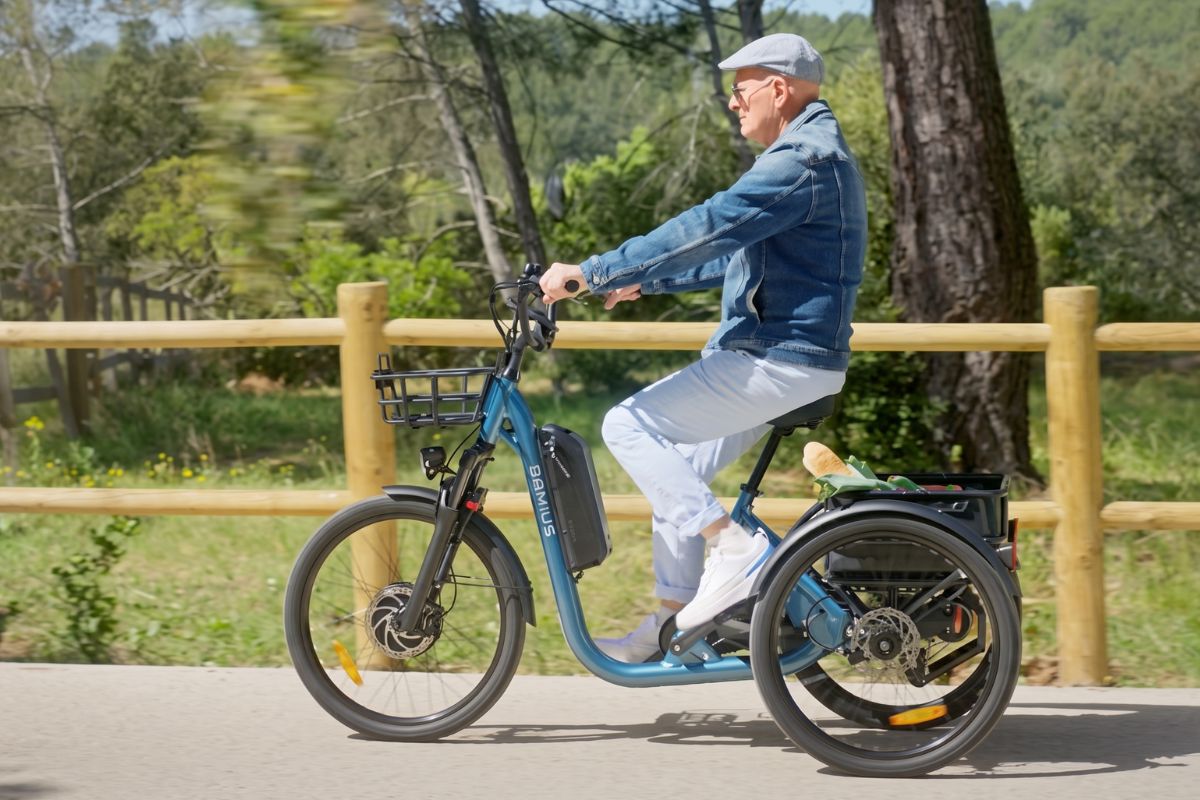
Our tricycles are designed for everyday use by adults, often seniors or people with reduced mobility, who want to get around freely without administrative constraints. No registration to obtain, no mandatory motorcycle helmet, no specific insurance, no licence. A Damius tricycle is ordered, arrives at your home assembled, and you can ride.
This choice imposes technical limits: 250W nominal power, assistance cut off at 25 km/h. These are limits we accept, and they match real, safe use. Beyond 25 to 30 km/h, the stability of an adult pedal tricycle deteriorates significantly in corners. The EPAC/VAE legal limit is not arbitrary: it also corresponds to a physical limit of the product.
The L2e category: what it really means
Faced with this legal gap, other players have chosen a different approach: attaching themselves to the L2e category of the Highway Code. Here is what this category officially states: a three-wheeled vehicle whose maximum design speed is equal to or greater than 6 km/h and does not exceed 45 km/h, fitted with an engine with a cylinder capacity not exceeding 50 cm³ if it is spark-ignition, or a maximum net power not exceeding 4 kilowatts for other types of engine.
Let us read these figures carefully. The power allowed in L2e can go up to 4,000W, i.e. sixteen times the EPAC/VAE limit. Speed can reach 45 km/h. And above all, nothing in this definition requires the motor to intervene only as support while pedalling: an L2e can operate entirely via a throttle, without pedalling at all.
L2e is not the category for electric-assist tricycles. It is the category for three-wheeled mopeds. We are talking about vehicles close to scooters, with a level of motorisation that has nothing in common with what an EPAC/VAE-type tricycle carries. Whether this framework should be applied to a pedal electric tricycle is debatable in principle, but technically possible since these tricycles have no dedicated category.
What some listings do not say
Electric tricycles are marketed in France with impressive technical claims: a 500W or 1,000W motor, 40 to 45 km/h speed, operation without pedalling, and the mention “L2e CE approval”. These claims are legally possible within the L2e framework. However, several important pieces of information are often missing from the listing or the sales contract.
Registration: an obligation the seller cannot ignore
An L2e-category vehicle must be registered to be used on public roads. This registration requires official documents provided by the manufacturer, including a European Certificate of Conformity (CoC). Without this document, registration is impossible. And without registration, the vehicle cannot legally be used on public roads, regardless of its technical performance.
However, in many cases, these documents are not provided by the seller at the time of purchase, or they arrive incomplete, or they do not match the delivered vehicle. The buyer then ends up with a very powerful, very fast tricycle that they cannot legally use on the road. This is not a hypothetical situation: it is a reality documented by consumer associations and specialist forums.
Helmet and gloves: not optional
A rider of an L2e vehicle is subject to the same obligations as a moped rider. Wearing an approved helmet (ECE 22.06 standard or equivalent) is mandatory. Wearing approved motorcycle gloves has been mandatory in France since 2016. Riding without this equipment is punishable by a fine, with points deducted if the rider holds a licence, and a fixed penalty.
This information is rarely highlighted in product pages that promote the freedom of not pedalling and the power of the motor. The buyer who thought they were simplifying their travel actually ends up with obligations similar to those of a scooter.
Speed and safety: a real physical issue
Beyond the legal question, there is a purely physical one. A tricycle with a wide rear track, as designed for adult and comfortable use, is not stable at 40 or 45 km/h in corners. The centrifugal force applied to the two rear wheels during a change of direction is proportional to the square of the speed. At 45 km/h, it is three times higher than at 25 km/h. The risk of lateral rollover in a corner taken at high speed is real and significant.
This is one of the reasons why Damius limits its tricycles to 25 km/h. It is not only a regulatory constraint: it is a limit that corresponds to what this type of tricycle can do safely. Exceeding this limit for marketing reasons, without informing the buyer of the real risks, is a form of deception that we refuse.
Worse still, very often so-called “L2e” tricycles are not tested under the conditions of this standard. So the marketing claims that are possible within the L2e category are highlighted on product pages, but the tricycle itself remains a conventional tricycle: its frame, brakes, and handlebar are bicycle components designed for bicycle use, and therefore not at all sized for a 45 km/h crash test.
How can you check the legal status of an electric tricycle before buying?
A few simple questions can quickly place an electric tricycle within the correct legal framework.
First: what is the motor’s nominal power? If the seller states 250W nominal and assistance cut off at 25 km/h, it falls under the EPAC/VAE legal framework. If the stated figures exceed these values, the product falls outside the EPAC/VAE framework and necessarily enters another category that involves administrative obligations and more.
Second: is the product equipped with a throttle that allows riding without pedalling? If yes, it cannot be classified as an EPAC/VAE in the regulatory sense, regardless of the other displayed characteristics.
Third: does the seller provide a European Certificate of Conformity (CoC) enabling registration? For an L2e vehicle, this document is essential. If it is not provided, or if the seller evades the question, it is a serious warning sign.
Fourth, more generally: does the offer seem too good to be true? A 1,000W tricycle, 45 km/h, operating without pedalling, sold online for €1,500 or €2,000 with delivery from abroad is not, in itself, a guarantee of quality. You cannot offer such specifications at those prices without cutting corners, and such a tricycle cannot legally be used on public roads without registration, an approved motorcycle helmet, and specific insurance. If the seller does not mention these obligations, either they are unaware of them or they prefer not to talk about them.
What Damius provides with every delivery
Each Damius tricycle is delivered with complete documentation: user manual, CE certificate of conformity within the EPAC/VAE framework, warranties. Our tricycles comply with the EN 15194 standards applicable to electrically assisted cycles in Europe. They require neither registration, nor mandatory insurance, nor a motorcycle helmet. You can use them on public roads, cycle lanes, and greenways without breaking any law.
This choice imposes technical limits that others try to bypass for a marketing and commercial advantage. However, it allows us to deliver a product you can use the day after it arrives, without paperwork, without constraints, and above all, fully legally.
Warning: using an unregistered electric tricycle on public roads when its characteristics require registration (power above 250W or speed above 25 km/h) is an offence under the Highway Code. Penalties may include a fine, immobilisation of the vehicle, and impoundment. In the event of an accident, the absence of mandatory insurance exposes the rider to serious civil and criminal consequences.
Our models: what they are and what they are not
Damius tricycles are electrically assisted cycles. They help you pedal; they do not pedal for you. Their motor stops assisting as soon as you stop pedalling or as soon as you reach 25 km/h. They are three-wheeled bicycles, not scooters. They share cycle lanes with other EPACs/VAE bikes or the road, as a conventional bicycle can.
If you have any doubts about the legal status of a tricycle you are considering buying, please feel free to discuss it with us. Mathis and Charly can help you compare the situations objectively. The number is 04 90 59 49 10, Monday to Friday. And if you would like to try a Damius tricycle with no commitment, our “Satisfied or Refunded” service allows you to test it at home for 14 days.
Regulations around adult electric tricycles are unclear, and some take advantage of this to sell technically impressive products while carefully keeping the real legal obligations quiet. Power and speed are strong marketing arguments. Registration, an approved motorcycle helmet, and approved gloves are less so. At Damius, we have chosen clarity: tricycles that comply with the EPAC/VAE framework, ready to use immediately, everywhere, without paperwork and in complete safety.
A question about regulations or our models? The Damius team will reply Monday to Friday.