There is no single “senior bike.” The term covers very different situations: a fit 65-year-old who wants to start cycling again for market runs does not have the same needs as a 78-year-old who wishes to keep moving despite joint pain or fragile balance. This guide starts from this reality: your bike must adapt to your abilities, not your age.
The 30-second choice
Independent senior, flat terrain: city bike with a low step-through frame or hybrid bike
Difficulties on hills or long distances: electric-assist bike (e-bike)
Reduced mobility, difficulty lifting legs: very open frame or no top tube
Balance problems: electric tricycle
Indoor use only: exercise bike
What is the best type of bike for a senior?
The low step-through city bike: the starting point
An open or swan-neck frame allows you to get on and off the bike without having to lift your leg very high. This is often the first criterion seniors mention, and it is legitimate. Combined with upright handlebars that allow you to stay straight, this type of bike is very suitable for daily trips on paved roads. It is lightweight, easy to handle when stationary, and generally well-equipped from the factory with mudguards, lighting, and luggage racks.
The electric bike: particularly useful after 60 or 70
Electric assistance does not replace pedaling; it lightens it. Concretely, a hill that used to leave you breathless becomes accessible, headwinds lose their effect, and you can cover 20 or 30 kilometers without arriving exhausted. It is not a gadget to “stop making an effort”: it is precisely what allows many people to continue riding when they would have stopped due to a lack of energy. One thing deserves to be said clearly: an e-bike involves pedaling. The electric assistance does not activate without pedaling, and the motor stops at 25 km/h. It is a bicycle, in the legal and practical sense of the term.
The hybrid bike for those who enjoy varied outings
The hybrid bike, often called a VTC, is more versatile than a classic city bike. It handles compact gravel greenways, rolling forest paths, or lakeside trails without a problem. It is not designed for off-roading, but it tolerates irregular surfaces better than a city bike with its slightly wider tires and softer fork. For weekend rides off paved roads, it is often the best compromise.
The folding bike for motorhome trips
Practical to store in a small space, the folding bike often appeals to traveling retirees. The point that is systematically forgotten: once folded, a folding bike weighs between 12 and 18 kg, or even more if it is electric, and carrying them up stairs or hoisting them into a trunk can represent a real effort. Check the weight closely before buying.
The tricycle for a senior with balance difficulties
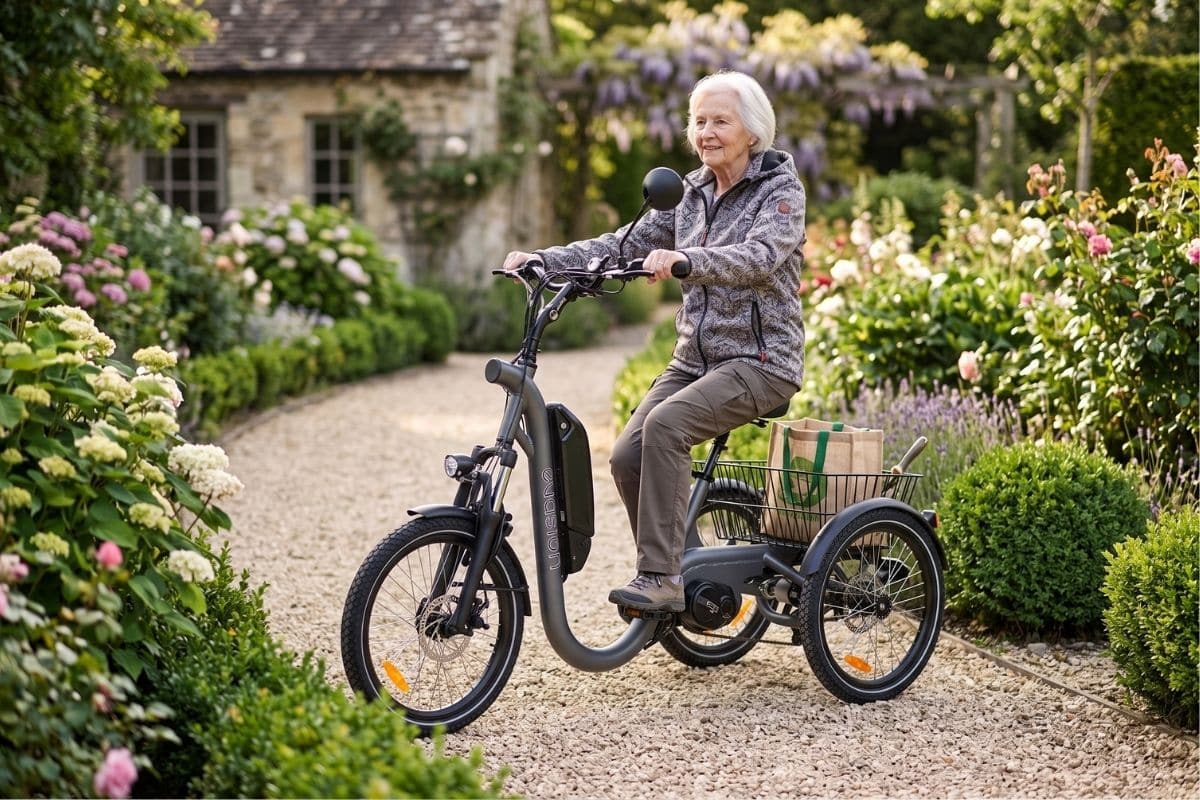
The tricycle with two rear wheels is the most direct answer to balance problems. It cannot fall over when stationary, it does not require putting a foot on the ground at red lights, and you can mount it without apprehension. In return, its behavior in corners is different from a two-wheeler: you must take curves with a bit more care and reduce your speed. The width of the tricycle must also be taken into account for city travel, narrow cycle paths, or building corridors. With electric assistance, the tricycle becomes particularly interesting: the effort at startup is reduced, and accessible distances increase significantly.
It is precisely in this segment that Damius has specialized since 2016, with several models designed for different uses and varied physical profiles.
The exercise bike to stay active at home
This is a very different intention from the previous ones. An exercise bike is not for getting around; it is for maintaining regular physical activity without going out. If this is what you are looking for, a specific article is dedicated to it. The two uses are compatible, but mixing both in the same purchase is rarely a good idea.
Essential criteria for choosing a senior bike
1. A frame that is easy to step through
The step-through height is probably more important than any other criterion. A frame that is too high forces a contortion every time you get on and off, and that is often where falls occur. This concept is independent of gender: a 70-year-old man with stiff hips has the same needs as a woman in the same situation. Look for a truly low frame, or better yet, a completely open one, as found on DAMIUS models.
2. Easily placing feet on the ground
At a red light or when stopping on a downhill, being able to place a foot firmly on the ground gives confidence and prevents imbalances. On a classic bike, this depends on the saddle height and morphology. On a tricycle, the question does not arise: the vehicle is stable at a standstill without needing to put a foot down.
3. An upright riding position
Upright handlebars allow you to keep your back straight and your head up, providing better visibility of traffic. It is also much less taxing on the back, arms, and wrists than a forward-leaning position. Most city bikes have these upright handlebars as standard; hybrid and sport bikes often require a modification. Damius tricycles have a particularly comfortable position with high handlebars and forward pedals; it feels like sitting in an armchair.
4. The weight of the bike
On an e-bike, many people do not realize that the battery alone represents 3 to 5 kg. Some electric models show 25 or 28 kg on the scale. Taking this bike out of the garage, hoisting it onto a car bike rack, or carrying it into a cellar requires real effort. You must be aware of this.
5. A suitable saddle
There is no real rule in this matter; if your bike’s saddle does not suit you, do not hesitate to change it—it is not very expensive and the mounting is standard. You sometimes have to test several before finding the one that fits. A small tip: proper height and tilt adjustment often make all the difference.
Hydraulic brakes require less force than classic mechanical brakes. This is an important point if you have a less firm grip or joint pain in your hands. It is also possible to adjust the reach of the levers so they are closer to the handlebars, reducing the necessary squeezing range.
7. Sufficiently wide tires
A wider tire absorbs road vibrations better and offers better grip on wet ground. Between 40 and 50 mm in width is generally the right compromise for roads and rolling paths. On fatbike models, tires exceed 70 mm and provide remarkable comfort on irregular surfaces, but at the expense of noise and battery range.
8. Simple and readable controls
On an e-bike, the screen must be readable in direct sunlight, buttons must be accessible without letting go of the handlebars, and assistance modes must be understandable without a manual. Some electric bikes have interfaces designed for sporty cyclists accustomed to technology: this is not necessarily what is needed when returning to cycling after a few years. Test the controls during the trial ride.
Electric bikes for seniors: what should you really look at?
Mid-drive motor or hub motor?
The mid-drive motor is placed at the bottom bracket. It distributes force more naturally because it relies on a torque sensor. On hilly terrain, it is generally more efficient. A motor in the front or rear wheel is mechanically less complex and less expensive to purchase. It is perfectly suited for travel on terrain with low elevation changes and does not require constant effort on the pedals, unlike a mid-drive motor which will be more powerful but will require a constant and sufficient effort on the pedals for the motor to deliver its full power. For use on the roads of Provence, Normandy, or any region with moderate hills, the mid-drive motor makes a real difference in terms of comfort during effort if you do not lack leg strength and/or endurance.
Engine torque, not just power
Nominal power is capped at 250 W for all legal e-bikes in France. What really varies between models is the torque, expressed in Newton-meters (Nm). A 40 Nm motor will be comfortable on flat terrain or with little elevation. As soon as you tackle a real hill or a path with sand or gravel, a higher torque, starting from 60 or 70 Nm, becomes appreciable. Damius Evasion Evo models reach 95 Nm on their mid-drive motor version.
Advertised range vs. real-world range
Manufacturers often communicate based on ideal conditions: flat terrain, mild temperature, minimal assistance, moderate rider weight. In practice, the range can be half as much if you climb in maximum assistance mode on hilly terrain. A battery advertised with an 80 km range might give you 40 to 50 km in your usual conditions. The battery capacity in Wh is reliable data for comparing models: the higher it is, the more margin you will have. At Damius, the advertised range is a real-world range observed by customers. We can say that on a tricycle, 100 Wh of battery capacity = 10 km of real-world range.
Progressive assistance is more important than raw power
This is a point that few comparisons address. On some entry-level electric bikes, the start of the assistance is abrupt: you press the pedal and the motor pushes hard immediately. When returning to cycling after several years, this behavior can be surprising and destabilizing. A progressive assistance system, which supports the effort rather than anticipating it, is much more reassuring for daily use.
Which bike according to age and physical condition?
Age alone does not allow you to choose a bike. Two 70-year-olds can have very different abilities depending on their health, previous physical activity, and any pain. Here is a breakdown by profile instead:
Profile
Recommended bike type
Good mobility, flat terrain
Low step-through city bike or hybrid bike
Good mobility, hills or long distances
City e-bike or electric hybrid bike
Mild joint pain (knees, hips)
E-bike with progressive assistance, adjustable saddle
Difficulty lifting legs high
Very open frame or tricycle
Fragile or unstable balance
Electric tricycle
Low endurance, returning after a long break
E-bike with multiple assistance modes, electric tricycle
Which bike after 60?
At 60, the majority of people do not yet have major physical constraints. The choice depends mainly on the intended use: short urban trips, weekend rides, or a desire to cover longer distances. A city e-bike or an electric hybrid covers most cases. If you do a lot of flat riding, a good non-electric city bike may suffice.
Which bike after 70?
It is often around age 70 that the first signs of breathlessness during effort, joint pain, or loss of balance appear. Electric assistance becomes more relevant. If balance or a lack of confidence on a bike starts to become an issue, the tricycle really deserves to be considered without prejudice: many people admit they should have made the move sooner.
Which bike after 80?
After 80, the question of balance and stability when stationary becomes central. An electric tricycle, properly adjusted and with suitable assistance, allows many people to continue going out and moving independently. It is also often the recommendation of physiotherapists to maintain regular physical activity while limiting the risk of falls.
Which senior bike in case of specific problems?
Knee pain or osteoarthritis
Cycling is often recommended precisely because the pedaling motion engages the knees without impact. Electric assistance reinforces this advantage: you continue to pedal, but with less resistance. Adjust the saddle height well; a saddle that is too low forces the knees to flex too much and worsens the pain. If in doubt about the ideal position, a postural assessment by a professional or in a specialized store is a good idea. A small tip: when stationary, pedal backward; the movement should be fluid. Adjust the saddle height if necessary.
Back pain
Upright handlebars and a straight position reduce pressure on the lower back. Wide tires absorb ground vibrations, which also helps. On a tricycle, the sitting position is generally more stable and less demanding than on a classic bike, as you do not have to work the core stabilizing muscles to maintain balance.
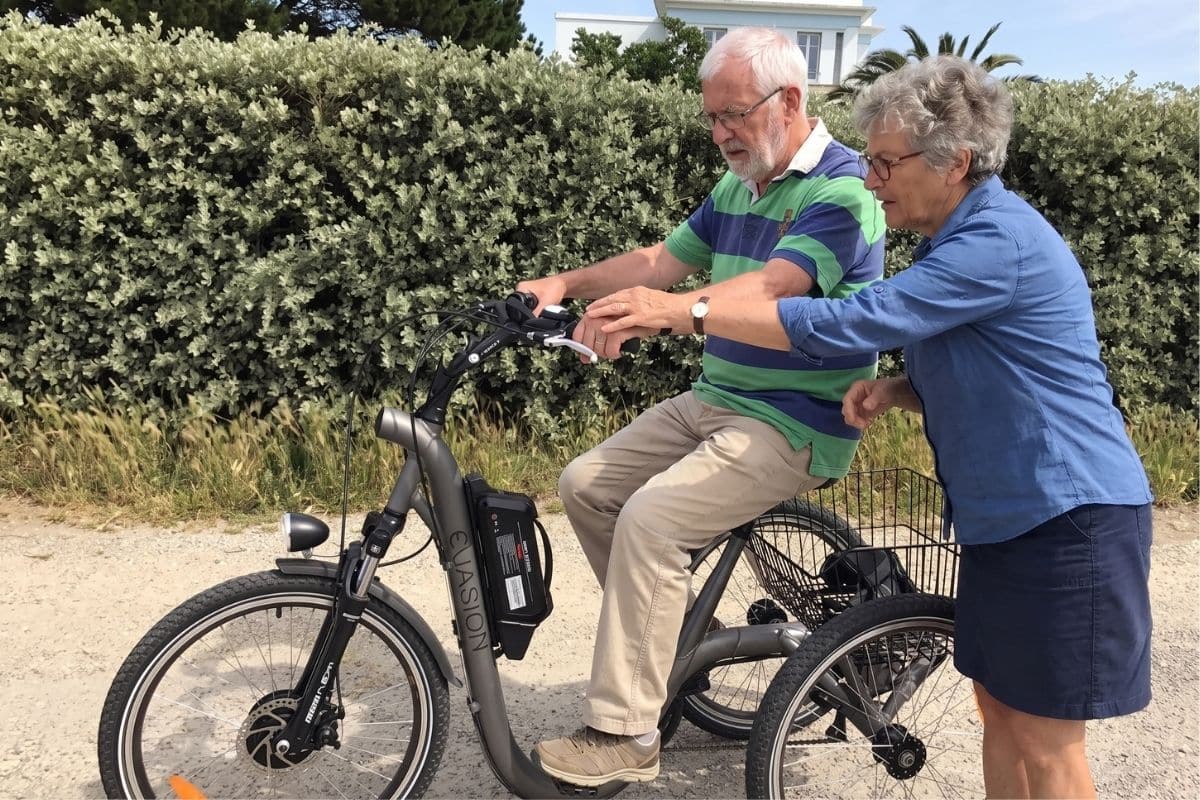
This is the number one criterion for choosing a tricycle or a very open frame. On Damius tricycles, there is no top bar to step over. You literally sit down as if on a chair. This is also one of the most concrete arguments put forward by Damius customers who made this choice after a hip replacement or knee surgery.
Lack of balance
A two-wheeled bike requires permanent balance, especially during the stopping and starting phases for a few seconds. A tricycle does not need it. If you have dizziness, vestibular problems, are in a period of convalescence, or if you simply no longer trust your balance, the tricycle is the only truly safe option.
Low hand strength
Hydraulic brakes reduce the necessary effort. The levers can also be adjusted to shorten the actuation distance. If you choose a bike with mechanical cable brakes and lack hand strength, check that you can handle the levers properly before any trip.
Returning to cycling after several years
Balance on a bike is rediscovered quite quickly, but confidence takes a bit more time. Start on a path without traffic or in a large flat area without obstacles. On a tricycle, this relearning phase does not exist: you pedal and you move forward, without fear of falling, though there will be a period of acclimatization to using a tricycle.
Damius electric tricycles
Designed since 2016 in Miramas, assembled and road-tested in Provence. Our advisors Mathis and Charly can guide you by phone: 04 90 59 49 10.
Essentiel — €2,490
The accessible tricycle for daily use. Electric assistance, disc brakes, differential as standard. Ideal for regular trips on paved roads.
Wide tires for increased comfort on irregular surfaces. Gravel paths, seaside, park alleys: this model goes everywhere where concrete gives way to something else.
Versatile electric tricycle, the best-seller in the range. Good balance between equipment, weight, and price. Suitable for a wide variety of profiles and uses.
Mid-drive motor with automatic gear shifting. The simplest model to use daily, without having to manage gears manually. Recommended for people who want to ride without worrying about mechanics.
Fear of accidents represents one of the main barriers to cycling among people over 60, according to a Cerema study published in collaboration with the Forum Vies Mobiles. This fear is legitimate, but it can be largely reduced by simple practical choices.
Prioritize cycle paths and greenways
Infrastructure separated from motorized traffic is by far the safest and most appreciated by senior cyclists. In France, the network of greenways has developed significantly in recent years. Before leaving, look at the route on a mapping tool like Géovélo or the OpenStreetMap map to identify car-free sections.
Resume gradually
If you haven’t ridden for several years, start again in a quiet place without traffic—a large square, an empty parking lot on Sunday, or a well-maintained greenway. A few short outings are enough to regain reflexes, especially stopping, starting, and turning.
Train specifically with an e-bike or a tricycle
An e-bike or a tricycle behaves differently from a classic bike. On an e-bike, the push of the assistance at the first pedal stroke can be stronger than expected. On a tricycle, the width and behavior in turns require a period of adaptation. A few sessions in a constraint-free place allow you to build these habits calmly.
Equipment not to be neglected
A helmet remains the best investment for safety. For seniors, a helmet with a rotational impact protection system like MIPS is recommended as it reduces the effects of low-speed falls, which are the most frequent. A rearview mirror, front and rear lighting, and light-colored or reflective clothing usefully complete passive safety. For legally required equipment on a bike, the dedicated public service page provides the full and up-to-date list.
How to adjust your bike when you are a senior?
Buying the right bike or tricycle is one thing. Adjusting it correctly for your morphology is another, and that is where many people miss out on a large part of the possible comfort.
Saddle height
In the low position, when the front of the foot is placed on the pedal at the bottom of the stroke, the knee should be very slightly bent. A saddle that is too low strains the knee and tires you out faster. A saddle that is too high causes the pelvis to rock with each pedal stroke, which is uncomfortable and a source of back pain. On bikes or tricycles with forward pedals to limit knee flexion, as is the case with Damius tricycles, you can afford a lower saddle adjustment. With the pedal at the bottom and the crank aligned with the seat tube, foot placed with the pedal in the middle of the foot, the knee must be slightly bent. To check, pedal backward; the pedaling motion should be fluid.
Saddle-to-handlebar distance
You should be able to reach the handlebars without leaning forward excessively or bending your elbows at a right angle. A forward or backward seat post, or an adjustable stem, often allow for fine-tuning this adjustment without changing the bike.
Handlebar tilt and height
Handlebars that are too low force you to lean, putting pressure on the wrists and lower back. Raising the handlebars with a riser stem completely changes the position and therefore the comfort. The tilt of the bars also influences the angle of the wrists: a few degrees sometimes make a big difference at the end of a ride.
Brake levers
Most levers allow you to adjust their proximity to the handlebars via a small adjustment screw. If your grip is small or your hands lack power, this adjustment is important. It is best to have it done in the store at the time of purchase and ask to be shown how to adjust it if needed.
Motor torque, derailleur, screen, standard equipment
What really deserves a higher investment: the motor (torque and smoothness of assistance), the battery (real capacity), hydraulic brakes, and the availability of after-sales service and spare parts. An electric bike bought for €800 on a large platform without a repair network can quickly become impossible to maintain and repair. This is a point that buyers often regret afterward.
Comparison table: which senior bike for which use?
Bike type
For which profile
Strengths
Limitations
Balance required
Low step-through city bike
Good shape, flat terrain
Lightweight, maneuverable, economical
No assistance, less stable
Yes
Hybrid bike
Varied outings, rolling paths
Versatile, wide tires
No assistance
Yes
City e-bike
Hills, medium distances
Assistance, lightweight
Balance still required
Yes
Damius electric tricycle
Fragile balance, reduced mobility, or desire for total comfort
Stable when stationary and riding, assistance, great comfort, storage basket
Wider, adaptation to turns
No
Folding bike
Motorhome, small spaces
Compact, transportable
Remains heavy once folded, small wheels
Yes
7 frequent mistakes when buying a bike for a senior
Choosing a frame that is difficult to step through. The salesperson says you will get used to it. You will not get used to it: either you will take risks every time you get on and off, or the bike will stay in the garage.
Choosing a motor that is too abrupt. Some low-end models start at full power from the first pressure on the pedal. This is uncomfortable and sometimes dangerous for someone returning to cycling.
Choosing solely based on advertised range. Range is always measured under favorable conditions. Divide by 1.5 to 2 to get a more realistic estimate in your usual conditions. Remember, 100 Wh of battery capacity = 10 km of real-world range.
Neglecting the position. A poorly adjusted bike causes back, knee, and wrist pain. Before concluding that a model does not suit you, check that the adjustments are well-adapted to your morphology.
Frequently asked questions about bikes for seniors
What is the most comfortable bike for a senior?
There is no universal answer, but the criteria that come up most are: upright position, low frame, wide tires (but not necessarily Fatbike), easy-to-operate brakes and, if balance or confidence are at stake, three wheels rather than two. A well-adjusted electric tricycle combines all these advantages.
Which bike to choose at 70?
At 70, an e-bike is often the right choice if mobility is good. If balance starts to be an issue, the electric tricycle becomes the safest and most comfortable solution. Age alone is not enough to decide: your abilities and your usage matter more.
Which bike to choose at 80?
The electric tricycle is generally the recommendation at this age, especially if there is any uncertainty about balance. It allows you to continue riding and moving independently, without fear of falling when stationary.
Is an electric bike suitable for seniors?
Yes. Electric assistance makes distances and elevations accessible that were no longer so, while maintaining physical activity. Pedaling is still there, simply lightened. This is one of the reasons why e-bike sales have grown most strongly in the 60-75 age group in recent years.
Which bike to choose when you have balance problems?
The electric tricycle is the only option that solves this problem at the source. A two-wheeled bike, even with assistance, requires permanent balance. A tricycle is stable both when stationary and in motion.
Which bike when you have trouble lifting your leg?
A very open frame, without a top bar, or a tricycle. On a Damius tricycle, the step-through is minimal: you sit down by passing a leg in front of the frame, like on a low chair.
What is the lightest electric bike for a senior?
The lightest e-bikes on the market are around 18-20 kg for high-end models. In the standard range, a good city e-bike weighs between 22 and 28 kg. For an electric tricycle, the weight is structurally higher due to the third wheel and reinforced frame, but the stability provided by the three wheels makes handling less problematic than a heavy two-wheeled e-bike that you must keep in balance.
Is a tricycle safer than a two-wheeled bike?
For people with balance difficulties, yes, without hesitation. The tricycle cannot fall over when stationary, does not require keeping balance while riding slowly, and offers a stable seat even in case of distraction. The handling is different, especially in turns, but after a few adaptation rides, the vast majority of users would not go back to two wheels.
What power should I choose for a senior electric bike?
In France, all legal e-bikes are limited to 250 W. What varies between models is the torque (in Nm) and the smoothness of the assistance. In most use cases, a 40 Nm hub motor is sufficient. For a mid-drive motor, especially for a tricycle, you should aim for 90 Nm and beyond.
Can you start cycling again after several years without practicing?
Yes. The automatisms related to balance on a bike are stored in procedural memory and generally return in a few minutes. If balance is fragile, start on a tricycle or in a place without traffic. Physical condition takes a bit longer to return, but a few short and regular outings are enough to regain a decent level.
Hesitating on the model?
Our advisors guide you for free according to your profile and needs.
An electric tricycle is significantly bulkier than a conventional bicycle. Depending on the retailer, it may arrive fully assembled and…
No more posts
Gérer le consentement
Pour offrir les meilleures expériences, nous utilisons des technologies telles que les cookies pour stocker et/ou accéder aux informations des appareils. Le fait de consentir à ces technologies nous permettra de traiter des données telles que le comportement de navigation ou les ID uniques sur ce site. Le fait de ne pas consentir ou de retirer son consentement peut avoir un effet négatif sur certaines caractéristiques et fonctions.
Fonctionnel
Always active
Le stockage ou l’accès technique est strictement nécessaire dans la finalité d’intérêt légitime de permettre l’utilisation d’un service spécifique explicitement demandé par l’abonné ou l’utilisateur, ou dans le seul but d’effectuer la transmission d’une communication sur un réseau de communications électroniques.
Préférences
Le stockage ou l’accès technique est nécessaire dans la finalité d’intérêt légitime de stocker des préférences qui ne sont pas demandées par l’abonné ou l’utilisateur.
Statistiques
Le stockage ou l’accès technique qui est utilisé exclusivement à des fins statistiques.Le stockage ou l’accès technique qui est utilisé exclusivement dans des finalités statistiques anonymes. En l’absence d’une assignation à comparaître, d’une conformité volontaire de la part de votre fournisseur d’accès à internet ou d’enregistrements supplémentaires provenant d’une tierce partie, les informations stockées ou extraites à cette seule fin ne peuvent généralement pas être utilisées pour vous identifier.
Marketing
Le stockage ou l’accès technique est nécessaire pour créer des profils d’utilisateurs afin d’envoyer des publicités, ou pour suivre l’utilisateur sur un site web ou sur plusieurs sites web ayant des finalités marketing similaires.